Wednesday, May 30, 2007

The "Iron Lady" Or "The Immaculate Misconception?"

During her over eleven year stay at Number Ten Downing Street, Margaret Thatcher inspired emotional responses from revulsion to adulation and analyses from scathing to laudatory. This characterization of the responses to Thatcher’s governments also broadly describes much of the writing about them both during and after their duration.

Political ideologies are notoriously hard to characterize definitively, and Thatcherism is no different. The most that can be said of a definition of Thatcherism is that it encompasses a certain set of principles, values and ideas that hint at policy directions but do not themselves represent any specific policy direction. This difficulty of defining Thatcherism is reflected in much of the writing on Thatcher’s politics.

Dennis Kavanaugh broadly defines Thatcherism as an ideology that supports the values of a strong state and a free economy. In an attempt to further nuance this broad definition, Kavanaugh argues that Thatcherism is best presented in terms of propositions. These propositions help to characterize the main features of Thatcherite ideology. They include limiting government power over individuals, allowing generally for more individual freedom of choice, promoting economic growth through free markets and insuring that the state is adequately equipped to maintain law and order at home and abroad. Kavanaugh, as will be seen with other commentators, also characterizes Thatcherism as a fissure with the past. He argues that her ideology, considered by itself as an ideology, represents a departure from the “Butskellite” consensus of the post-war years and shows a new departure in British political thinking.

Peter Riddell, somewhat differently, begins his definition of Thatcherism with the assertion that it is much more a series of moral values and an approach to leadership than anything approaching an ideology. Riddell argues that these moral values can be defined as “Victorian,” and encompass such notions as self-respect, initiative, choice, freedom, conviction, duty and faith. Also important for Riddell are the ideas that Thatcher is on a “mission” to save Britain and that in this mission she is confident, dominant and has the courage of her convictions.


Eric J. Evans states, more definitively than Kavanaugh or Riddell, that Thatcherism does not represent a coherent political ideology in any meaningful sense of the term. Evans argues that Thatcherism has an ideological nature, but it is best understood as a series of precepts similar to those enumerated by Kavanaugh and Riddell. Evans further asserts that the importance of Thatcherism lies not in the novelty of its ideas (something he, Kavanaugh and Riddell all deny) but in the specific political context of the late 1970’s and 1980’s. In this context, Evans locates the novelty of Thatcherism in the fact that Thatcher actually believed in precepts that most politicians of the day, even other Conservatives, found “unbelievably crude and shallow.” This, coupled with ideals that had been instilled (and remained) with her by a domineering father in a lower middle class, non-conformist home-hard work, responsibility, thrift, prudence-became the driving force of her personal ideology and by implication her policy agenda.


Distilling these moral propositions and proclivities which would come to define (in one way or another) her policy goals and agendas, Hugo Young posits that Thatcherism is best understood as the interaction of two personal qualities that define Thatcher and her view of the world. The first of these is moral rectitude; her appeals to righteousness colored her policies and her understanding of her role as Prime Minister. The second was pragmatism, which could soften convictions and allow for compromise in order to secure the greater political good (and stay in the good graces of the electorate). These two personal qualities intertwined and reacted on each other to form, for Young, what would come to be called Thatcherism.


Another Thatcher biographer, John Campbell, sees in Thatcherism an apparent paradox. While he also sees that Thatcher’s “moral compass” was set by her upbringing and were essentially conservative, old-fashioned and puritanical. Campbell sees these values at odds with what he calls a “culture of rampant materialism.” She believed in thrift yet incurred record government debt; she supported the idea of the family but also furthered policies that fragmented families and made them endure economic hardship; she believed in the uniqueness of Britain but her policies didn’t reflect anything that was necessarily uniquely British. Campbell asserts that Thatcher rode this seeming liberalizing tide in society and the economy, “averting her eyes” from the consequences when something insulted her values. How could she manage such dissonance?

Campbell posits the notion that the real unique quality of Thatcherism is that Thatcher discovered that most of society is middle class. Most post-war governments, according to Campbell, seemed to assume that the bulk of society was working class, and thus worried about such things as unemployment. Thatcher saw society, at least by the late 1970’s, for what it was-predominantly middle class and thus concerned with prosperity and consumption rather than production. She took advantage of this realization by tailoring her ideology and policy to making sure the middle class felt prosperous and therefore friendly to the government. The paradox is thus explained: Thatcher was a class warrior, but for the middle class. It was her abiding values, coupled with the realization that the socioeconomic nature of Britain had fundamentally changed, that best define Thatcherism as an ideology.


In considering the last of the broad interpretive factors surrounding Thatcher’s time as Prime Minister, that of her leadership style and legacy, certain prevalent themes emerge. One of the most important of these is consistency. In a much-quoted speech to the Conservative Party Conference in October of 1980, Thatcher proclaimed “You turn if you want to. The lady’s not for turning.” Bruce Arnold argues that this predilection for consistency was a ruse, that Thatcher manufactured this notion that her views were unchanging. She was, in fact, perfectly willing to compromise and change as she had done many times in the past.

Thatcher, argues Arnold, like all politicians was adept at telling people what they wanted to hear. Young encapsulates his view of her leadership style in the phrase “one of us.” He argues that Thatcher sought out and found like-minded “fellow travelers” on her quest to remake Britain and save it from decades of decline and a pervasive national malaise.

Young also argues that Thatcher was driven by a sense that she was immersed in a constant battle, always with her “back to the wall.” Thatcher would, ultimately, win these perceived pitched battles because she saw herself on a quest to save Britain and make her great again.


Another broad characteristic of Thatcher’s leadership style is the lack of a search for consensus in policy or ideals. Riddell argues that this lack of interest in forging consensus was defined not so much by her policies but by the aforementioned “Victorian” values: middle class achievement, striving, sound money, family and the assertion of Britain’s role in the world. Riddell also argues that it was these views, coupled with the policies that were inspired by them, that led Thatcher to become popular with her “new Tory” supporters in the working class. This notion, conversely, also led her to clash with members of the “Establishment,” senior civil servants, academics and other sectors of the middle class for whom the maintenance of the post war consensus was important.

This point is also underlined by Kavanaugh in saying that Thatcher is much more of a “mobilizing” sort of leader rather than a “reconciling” sort that Thatcher’s so-called “mobilization” leadership, coupled with her focus on core values led to the problems in her cabinets. This problem in keeping ministers is most starkly underlined by the fact that by her resignation in November of 1990, she was surrounded in the Cabinet Room not by friends or people whom she trusted.


Margaret Thatcher’s legacy and the historiographical view taken of her are, as could be noted of many politicians, a mixed array of triumph and failure. Considering the academic commentary on Thatcher and her premiership, certain conclusions begin to present themselves.

Thatcherism is best understood not as an ideology, for it has poorly defined contours, uncertain boundaries and no plan of action dictated by its precepts. It does, however, have an ideological nature, based on certain core values that can be called “conservative”: a belief in self-reliance, the rights of the individual, a minimum of state intrusion and the place of Britain in the world as one of its great powers. It is these values, coupled with a leadership style that values consistency and a lack of consensus that best defines Thatcherism. It is not an ideology nor is it a style of leadership; it is a combination of the two with the unique personality of Thatcher herself.


In considering Thatcher’s policies, the most persuasive view, combining much of the academic writing on the subject, is one of mixed success and failure. Her economic policies, inspired by her values, did seem to improve the economic lot of the nation, or at least certain sectors of the population, such as the middle class and the more affluent working class. More generally, Thatcher’s policy seemed to lead to an increased sense, certainly by the 1987 election, of prosperity across the nation and a more secure feeling that Britain’s economy was finally back on track.

Thatcher’s other great area of success that of winning elections must also be viewed in their context. It may be true that the Conservatives won in 1979 and 1983 because Labour was weakened, disorganized and out of step with the electorate. This, while less the case in 1987, showed the strong hold that the Thatcher image and style had come to have over the British electorate. The shifting nature of the support for the Conservatives, however, redefines this notion of the strong hold of the Conservative message. With the growth in working class support, the Conservatives saw a decline in support in their traditional “stronghold” of the middle class. This was due to Thatcher’s style, her lack of concern with consensus and a growing feeling that the prosperity they enjoyed was not her doing, but the result of economic forces out of the government’s control. In this light, therefore, Thatcherism (such as it was) may be seen as a victim of its own success.


Margaret Thatcher stands as one of the seminal British political leaders of the twentieth century. Her blending of ideology and policy, style and substance into a seemingly coherent ethos for her age is a marvel of political image making and skill. While her policies had rather mixed results, her personality as it constituted her image showed all of the marks of a master of the art of politics. In a certain sense, the last chapter of the Thatcher legacy is yet to be written. As the Conservative party of the 1990’s, under the leadership of John Major, presided over an again sagging economy, increased dissention over Britain’s place in Europe and a nascent Labour Party under Tony Blair, the Thatcher legacy is still very much an open question. While Thatcher the politician is truly a study in ideology blended with style to produce results, Thatcher the policy maker’s effect on Britain must be viewed much more cautiously. The “Iron Lady” will continue to fascinate and complicate the discussion of late twentieth century British politics for generations to come.

Bibliography

Arnold, Bruce. Margaret Thatcher: A Study in Power. London: Hamish
Hamilton, 1984

Bruce-Gardyne, Jock. Mrs. Thatcher’s First Administration: The Prophets
Confounded. London: Macmillan, 1984.

Butler, David and Dennis Kavanaugh. The British General Election of 1979.
London: Macmillan, 1980.

Butler, David and Dennis Kavanaugh. The British General Election of 1983.
London: Macmillan, 1984.

Butler, David and Dennis Kavanaugh. The British General Election of 1987.
London: Macmillan, 1988.

Campbell, John. Margaret Thatcher, Volume 2, The Iron Lady. London:
Jonathan Cape, 2003.

Evans, Eric J. Thatcher and Thatcherism, 2nd ed. London: Routledge, 2001.

Gilmour, Ian. Dancing With Dogma. London: Simon and Schuster, 1992.

Jenkins, Peter. Mrs. Thatcher’s Revolution: The Ending of the Socialist Era.
London: Jonathan Cape, 1987.

Kavanaugh, Dennis. Thatcherism and British Politics: The End of Consensus?
Oxford: Oxford University Press, 1987.

Riddell, Peter. The Thatcher Government. Oxford: Basil Blackwell, 1983.

Walters, Alan. Britain’s Economic Renaissance: Margaret Thatcher’s
Reforms, 1979-1984. Oxford: Oxford University Press, 1986.

Young, Hugo. The Iron Lady: A Biography of Margaret Thatcher. New York:
Noonday, 1990.

Tuesday, May 29, 2007

Welcome Back, To That Same Old Place That You Laughed About

Yes, yes I know...it seems that the Bears loss in the Super Bowl caused me to fall off the face of the Earth.

Well, I assure you, all I did was fall of a barstool (or two) and into one of the busiest and most productive semesters I've had in some time. It really does seem to ring true that the more you do, the more you can do.

I hope to bring you my trademark blend of angry rant and intellectual discussion, and oh brother, we have a lot to discuss.

Before we launch into things that I want to talk about, how 'bout you the (hopefully) returning readers of COTL?

In an attempt at outreach (and to stir your interest again, or at all), and at the risk of doing something incredibly stupid, I will make this offer.

Each reader gets to ask me one question...anything at all (when I say anything, I do so with the understanding that my parents read this thing, but oh well, I was the dumbshit who wanted to do this).

Go ahead, hit me with your best shot.

Oh, and check out my two new posts: a book review and some musings on my first semseter teaching people something.

(Extra points for the name of the sitcom from who's theme song I stole the title for this post).

Journey To The Other Side Of The Desk

I recently completed my first teaching appointment as a teaching assistant in the history department. I have to admit I went into this whole exercise a bit reticent...here I am, for the first time doing something close to what I will (hopefully) do for the rest of my life. What if I think it sucks? What if I am really bad at it?

Legitimate concerns, or at least I think they were.

Well, turns out that I don't think it sucks and apparently I am not really bad at it. In fact, it seems that I have somewhat of a knack for these things.

(Huge sigh of relief).

I TA'ed a 400-level (mostly juniors and seniors) class on the history of Imperial Russia, 1801-1917, a subject that I have a lot of experience with. If there is a European country that I know almost as well as Britain or Ireland, it's Russia. It is an interesting time period: defeating Napoleon, the Crimean War, the Great Reforms, the 1905 Revolution. Interesting people therein, too, everyone from Pushkin to Rasputin to Sergei Witte to Konstantin Pobedonostsev and many, many more.

I got to crush commonly held misconceptions (the British were the central factor in the defeat of Napoleon, all the tsars were iron-fisted autocrats, Russia was the most centralized state in Europe) and reinforce others (all of the bad stuff you know about Nicholas II is all true). Wars, famines, revolutions, angry peasants, clueless nobles, raving revolutionaries...great stuff.

It took a few weeks to deal with some things, like the awkward silences (seems the best thing to do is let them stew and wait for someone to speak up) and the leading them where we needed to go (especially toward the end...dealing with senioritis sucks even more than having it).

All in all, I think everyone had a good semester, we learned, we laughed (usually at my feeble attempts at humor...I told a really bad joke about Lenin), we looked at a lot of maps, read hilarious (to me, at least) political cartoons from the Crimean War. It was great.

I also must admit that the ability to score people's performance, on a scale of my choosing, was a power that I have looked forward to having...it is not easy, but if you set definitive boundaries and make expectations as clear as possible, people at the very least cannot claim that their grades were given at random (although after fifty-six final exams, I was tempted by this system).

I thought it was a frightfully good wheeze overall...some of my students would not agree with that assessment...their fault, really.

Stone Cold Freak (Economics Version)

Levitt, Steven D. and Stephen J. Dubner. Freakonomics: A Rogue Economist Explores the Hidden Side of Everything. New York: William Morrow, 2005.

When books like this sell a bunch of copies, people like me naturally become suspicious. I guess it is the knee jerk reaction of denizens of the "ivory tower" to automatically sneer at an attempt to "popularize" some aspect of academic thinking. In fact, being called a popularizer is about as bad a thing that you can call any academic. Like being called a child molester, it is a tough label to wash off.

What I do know is this: Levitt and Dubner sold more copies of this in a week than some academics sell in an entire career. I am a bit of a heretic, but I think that there is something to be said for that...along the lines of "laughing all the way from the ivory tower to the bank, several times."

This book did more than sell a bunch of copies; it sold a shitload of copies, and for a book that even hints at the fact that it is about economics, that is something indeed. The "dismal science" is not one that seems to interest a lot of people, but it is like many of the humanities and social sciences...present it well and people will become interested and perhaps learn something in the process.

First off, this book is easy to read, funny in parts and a well crafted book (due in no small part to the involvement of a journalist...when academics try to do these things on their own, it is usually a disaster). It does make good summer reading (at least for someone like me). It is not, however, the funniest book on economics out there: that goes without hesitation to P.J. O'Rourke's 1999 book Eat the Rich: A Treatise on Economics.

What the authors (principally Levitt) argue is that if morality represents the way people would like the world to work, economics represents how it actually does work. While eschewing that there is any central point to the book, Levitt and Dubner do proffer some key notions that do center the work.

These being that incentives are the cornerstone of modern life; conventional wisdom is often wrong; dramatic effects often have distant, even subtle, causes; "experts" use their informational advantage to serve their own agenda; and knowing what to measure and how to measure it makes a complicated world less so (13-14).

Well, that seems simple enough, almost simple that it should not take an economics professor from the University of Chicago and a New York Times journalist to figure them out. That is exactly their point and what makes their book so enjoyable and accessable. They show economics (and by implication most of the social sciences) for what they are - studies of how actual people behave and interact with each other and their surroundings.

Their case studies in the chapters that follow vary in interest level and novelty from things that a six year old could tell you (everyone, given the right payoff, will cheat) to the controversial (the decision in Roe v. Wade led directly to the decline in violent crime in the 1990's). All manner of data are marshalled in making these claims.

I found the chapters on crack dealers in the CHA housing projects, the reasons for the declining crime rates and factors that lead to success in parenting (Chapters 3, 4 and 5, respectively) particularly interesting, if for no other reason the methods employed to reach each conclusion. The story of how he got the data on the organization and economics of crack dealers is harrowing enough to be a story of its own (and in fact it soon will be).

The chapters on incentives and information-as-power seem like cases too easily made, and things that seem explanatory. We would not have common phrases like "everybody has his/her price" or "knowledge is power" if these were not intuitive notions. They do, however, speak at some length about how convetional wisdom is often wrong, but it seems that they make the exception in these two cases. The chapter on baby names and success (Chapter 6) just seems silly...we have a Secretary of State named Condoleeza (perhaps she is the exception that proves the rule, but I still think their argument is a stretch).

What this book does best is show people how economists and social scientists look at the world. Levitt says that economics is primarily a science of measurement. I partially agree with him.

I have always believed that economics is primarily a behaviorial science, studying what are some of the least generally interesting but some of the most important human behaviors. Unlike psychologists, who get to talk about fun stuff like crazy people, economists study things like incentives, opportunity costs, limited resources and unlimited wants and so on. Not the sexy (literally in some cases) stuff of Freud and the boys, but ultimately more useful in understanding how people interact with their world on a daily basis.

All in all, this book was a worthy read, even if some of the case studies are a bit far-fetched. They will leave you thinking "well, maybe they have a point there." Or maybe not.

Friday, February 16, 2007

Typical. For The Cubs, Anyway

This sort of baseball injury is absolutely hilarious. Only a Cub could do this sort of thing (or let it leak out, anyway).

I will return next week with some thoughts about the movie The Queen and how people understand and interact with history.

For weekend fun, try these fascinating philosophy games. They are a great (and smart) way to make those hours veritably whiz by.

Well, I must be off...my pot roast needs attention. Yes, it's O.K. to drool.

Wednesday, February 07, 2007

Human, All Too Human

That is the title of a book by Friedrich Nietzsche which oddly describes what the Bears were proved to be last Sunday.

They are only men, faced with a daunting task that they were not prepared to face. Grossman, badgered by the press and woefully patchy, fell (literally, a few times). Cedric Benson, one of the central prongs in our offensive attack was injured early. Our defense, bedraggled by punishingly long drives by the Colts were ragged and tired by the end of the game, not able to force the Colts into mistake.

We were just not up to the challenge. Indianapolis brough their "A" game; we brought cocksurety based on what turned out to be a rather rickety foundation.

As for me, I guess it was all for the best. A World Series Championship for my favorite baseball team followed not even two years later by a Super Bowl for my favorite football team might have upset an understanding that I have with my "sports fan" persona.

For, you see, I have been a Chicago sports fan (excluding the Cubs) for my entire life. I grew up in Chicagoland, worked and went to school in the city and am really tied to the place emotionally in a sense of rootedness, so that for me, Chicago is a "place" and not just a "space."

I learned a lot about life from Chicago sports. I learned that, most of the time, despite your good feelings and devotion, the world will break your heart. I also learned that disappointment is an emotion that can lead, with time, into a certain cavalier, devil-may-care attitude. Hey, I figure, we will probably lose it all, but let's have fun doing it. I am also acutely aware of how no amount of pleading to the god of your choice can change the outcome of such contests; they are measures of skill faced with luck, nothing more.

Yet, I and I suspect many, react emotionally to these matricies of skill and luck, performed by others for the enjoyment and entertainment of all. Why is this? I suspect that it comes from the need to believe in something, to have simple, blind faith in a proposition or a cause. We live in a time and place that suffers from a certain world-weariness, a lack of fascination with the world in general. Most people are interested in escaping the world than encountering it.

Sports give us a reason, well, not to be like this for a while. It allows us to put our faith in the skill and the Fates and let the conflict play out, trying to be amused and gain pleasure in the meantime. For that, I am eternally greatful to sports and to teams that win only occasionally.

I would hate to suffer the hubris of fans of more sucessful (historically, anyway) sporting endeavors. They take pleasure and satisfaction as a given; I, however, take it as something to reach for and sometimes get but mostly not.

To close, am I glad about what happened last Sunday? Of course not.

Would I take back my support if I could? Not on your life.

Go Bears.

Friday, February 02, 2007

A Certain Team From A Certain Town...


...that begins with a "c" ends with an "o" and has "hicag" in the middle.

I expect that you figured I would only be silent about this for so long...consider the silence broken, my friend.

Oh, and by the way, go here for all you Superfans memories, my friend.

What to say about the Bears in a Super Bowl? Did I think it was possible at the beginning of the year? Sure, I always do (when you grow up a Chicago sports fan, hope always springs eternal). When did I think we were for real? Not sure, but Arizona on Monday night, and our performance therein, really showed me what we were made of. The rest of the season, well, apart from the little hiccups against New England and Green Bay (a fluke), could not have been better.

What will it take to win this game? I am no expert (nor am I completely without knowledge), so I will say that a combo of the running games of Thomas Jones and Cedric Benson with a solid Grossman performance and back-up from the D will serve us in good stead. People who are worried about Grossman should read here what Rick Telander had to say. Problems? While people say a lot of nice things about Peyton Manning, and some of them may be true, he will have to contend with some blistering resistance...and there is one more thing...

The Peyton Manning Playoff Choke Factor.

Aside from the main event, this naturally is the reward for years of loyal support on the part of Bears fans, myself included. To see your guys finally in the big show is nothing short of kickass. When I think back on the lean years (Ditka's final years, Dave Wannstead and the eerily emotionless Dick Jauron), all the embarassing seasons while another Midwestern football team seemed so dominant. All those Sundays wondering when the hurting would ever stop.

Well, the time is now.

Oh, and to all the people who doubted us and just hated us for who we are, well, where are your gods now?

As predictions go, and I always hate making these, even nuns say that we are going to win.

FINAL SCORE: CHICAGO 31, INDIANAPOLIS 24

Well, that's about all I have to say apart from...

BEAR DOWN CHICAGO BEARS!

P.S. For great, totally biased Bears coverage, go here, to WBBM, the radio home of the 2006 NFC Champion Chicago Bears (sounds great, don't it?)

Wednesday, January 17, 2007

Feeling Confused? Just Ask Mao!


Unsure of what the next move is? What your next step should be? Unsure of your place in the cosmos? Can't decide what's for dinner?

Well, your ship has come in...your Chinese Communist ship, that is.

So, why don't you take a "Great Leap Forward" into a new "Cultural Revolution," and ask Chairman Mao himself with the Chairman Mao Saying Generator!

Simply key in your question and the Chairman's wisdom will flow forth like the mighty waters of the Yangtse.

You never know what part of the "Little Red Book" could have the answers, so hit old Mao with your best shot.

I also love, by the way, that the website says that it "takes the stress out of Socialism." My response is you cannot be stressed when you are dead.

Give it a try! The impending victory of Mao Tse-tung Thought is upon us!

Tuesday, January 16, 2007

Madison's Snow Problem: Too Much, Not Enough, And Echoes Of Bilandic

...and no, I am not talking about the favorite recreational Bolivian export of futures traders, Robert Downey Jr. and Eurotrash everywhere. Although, if you know the right people to ask on Langdon Street...

I am talking about something that we used to be up to our ears in at this point of the year: snow.

South Central Wisconsin got its first appreciable snowfall Saturday and Sunday and this, as you may have guessed, generated something that made me mad. Two things, actually.

First, a question. What is the stupidest thing to do when you have a snow-themed event and you know snow is coming your way. Why, buy sixty dumptrucks full of the stuff beforehand!

I am not joking, for this is what happened to facilitate the "Capital Square Sprints" skiing tournament this weekend. Forget egg on the face of the City of Madison...the sixty trucks of snow are plenty embarassing enough.

They actually had to do this last year for the same event and it causes one to wonder: how much revenue could a skiing tournament possibly generate versus all the money wasted putting it on? How much is generated in revenue for the city and local businesses to make it worthwhile to truck in snow for what amounts a lot of people going around in circles. Maybe it is that I am not a skiing enthusiast (big surprise there, I know), but it seems like a colossal boondoggle that probably operates as a loss for the city.

I will not forget this when, in four years, I make my unsuccessful bid for mayor.

The other story comes this morning, another tale of smart use of public funds. Apparently, Madison is getting GPS tracking for, wait for it, its snowplows. According to the story in the Wisconsin State Journal, this will save money in the long run by cutting running costs, wear on equipment and prevent areas already plowed from being done again.

To plow an area again it must first be done, well, a first time. This sometimes does not happen for days, in a centralized urban area in the state capital of a state where it snows all the time.

Look, Mayor Dave, I'll save you the money and give you some advice. There is an urban area to the southeast of you called Chicago, and there, a very different philosophy prevails on the subject of snowplowing.

For you see, there was a mayor named Michael Bilandic and he basically handed Streets and Sanitation (who oversaw snowplowing) to the Outfit and they promptly pillaged all of the city's funds for snow removal. In a year when there was little snowfall, this would not have been a problem.

Fate, unfortunately, had another card to play for Mr. Bilandic.

On Friday night, January 12, 1979, it began to snow steadily in Chicago. It stopped at 2:00 on Sunday morning, January 14. On top of a ten inch base left over from a storm on New Year's Day were a fresh 20.9 inches of snow. With depleted funds and crews of the sorts of people who don't let their day jobs interfere with their regular lives, the city, rapid transit and all, came to a grinding halt. Garbage piled up, bodies went unburied and rats flourished. Bilandic was powerless to do anything as he watched while his corrupt and inadequate Streets and San crews lumbered throughout the city.

Also fatefully inconvienent for Bilandic was the fact that there was to be a mayoral election in February. When Chicagoans went to the polls, feet still caked in dirty snow, they dealt the mayor a resounding defeat, due in no small part to the corrupt and inept handling of the Blizzard of 1979, as it came to be called.

How did this change things in the metro area, you ask? The minute flakes begin to fall, the plow trucks roll, not like Madison where they wait until it is done, packed down and frozen over to fire up the now GPS equipped plow trucks.

So, Mayor Dave, take a page out of the Chicago playbook...forget GPS and just, well, get out there and plow and salt the roads. Oh yeah, and don't allow the Outfit to get hold of jobs and cash in City Hall. Somehow, I don't see that happening here. Politics are shrill yet boring in Madison, a lot of heat without a lot of light. I guess I like a good and corrupt city government; makes for better reading in the papers.

In your new plowing efforts, why not start with South Franklin Street, hmm?

Tuesday, January 09, 2007

Would "Go Deep" Work And De-Lurk Already!

Thanks go first to Greg for his always august commentary on the commentary on this site.

Second, following up on yesterday's consideration of Iraq, there was an interesting opinion piece in the Times today by Amir Taheri. In the rubric of proposals dubbed "go big," "go long," or "go home," Taheri suggests an interesting fourth choice: "go deep." Read it here and see what you think.

Lastly, I have been informed by the blogs of a few dear friends that it is National De-Lurking Week in the "blogosphere," a word that I personally dislike.

So, if you regularly stop here (or have unfortunately landed here due to the vagaries of Google), surface, identify yourself and say hello.

Just so you know, you do not need an account with Blogger to leave a comment; on the comment form, simply click "other" and type in your name, pseudonym, prison ID number, whatever.

If you are ashamed that you read my ravings, well, I understand. Really, I do.

Monday, January 08, 2007

What I Think About Iraq

It is the biggest news story of the day (and has been for some time), yet I have barely given it a mention in this space. Why, you ask? We get blitzed by so much information about the situation (or so we think) on a daily basis that the absolutely dire situation on the ground has become so much white noise to us and seemingly to our leadership.

There is some gruesome truth to the words of Josef Stalin: "One death is a tragedy. A million deaths is a statistic."

So, with the risk of oversimplyfying an extraordinarly complex situation, here are two possible scenarios:
  • We go with what seems to be President Bush's new plan...the vaunted "surge." We will know for sure on Wednesday, but if press leaks are to be believed (they seem to be one of the few clear channels of communication anymore), Mr. Bush wants to make a final surge with 20,000 new troops to quell the violence in Baghdad, rid the city of Sunni insurgents, Shi'ite militias, Ba'athist loyalists and then get on with the program of rebuilding civil society so that political stability can flourish and our troops can finally come home.
  • We go with the plan proposed by the Iraq Study Group and (as it seems) the one supported by the new Democratic majority in Congress. This would not give the president a "blank check" to spend more money and would instead couple phased troop reductions with a diplomatic offensive in the region to attempt to enlist the support of other states in the region in quelling violence and re-establishing some semblance of order, especially in and around Baghdad.

Will either of these new strategies work? Of course not.

Let's take the President Bush plan first, shall we? The notion of a "final push," one last effort by a bewildered fighting force to give it a final go and maybe defeat the enemy is as misguided for overall policy as it is suicidal for the troops involved. 20,000 new troops? From where? Even if we can field this many people, it will be little more than a drop in the roiling bucket that is Baghdad. A final push? When, in modern warfare, has this ever worked? All it will succeed in doing is sending more troops, condemned by this damnable strategy, to the morgue.

Why would the president suggest such a plan? Surely he has heard the heel and cry from all corners, official and otherwise, that this war has no popular support left to fuel it. People from top military brass to Congressional leaders on both sides of the aisle to Henry Kissinger have said that a military victory is impossible. Why then the continued drive to such an elusive victory?

I can say it no better than it was said by MSNBC's Keith Olbermann in a commentary on his show "Countdown" last week. Watch the video here. In fact, peruse the list of all of his special comments here. They are all outstanding.

The president is never wrong. He never apologizes. He is consumed by his own superinflated ego and backed by a vice president who is likely the mastermind behind this total and unmitigated failure. A grim echo of Henry VIII and Cardinal Wolsey, indeed.

What then of the Iraq Study Group plan, and the one that Nancy Pelosi and Harry Reid seem to support? Equally unworkable. Diplomatic offensive in the region? To whom will we be dispatching these armies of diplomats? Iran? Saudi Arabia?

The best that could be hoped for diplomatically is to become more engaged in the Israel-Palestine peace process, something that has not occured in the State Department under Condoleeza Rice. What will this do? Maybe nothing, but it sure seems (and when did you ever expect to hear this) that there is a greater chance of success dealing with the Palestinians and their elected leadership (which we wish had not been elected) than, well, whatever else is on offer.

Can Iran be dealt with diplomatically? After all, it has been the case for some time that the dominant political and economic mover in the region is no longer the predominantly Sunni areas led by Saudi Arabia, but the Shi'ite orbit headed by Iran. Years of feeble sanctions and diplomatic buck-passing put us in the situation we are in with Iran and allowed them, with considerable help in the fact that the Soviet Union collapsed when it did, to get the knowledge and materials to go nuclear.

So, no, to answer the question, Iran COULD have been dealt with diplomatically but it is too late for that. Any diplomatic overtures to Iran, seen in the light of their incessant baiting of Israel, will call into jeopardy our relationship with the Israelis, as these overtures will be seen as ignoring Ahmadinejad's Holocaust denial and aggressive nuclear strategy. If anything gets started with Iran it will be by Israel, who has dealt with Iran's funding of Hizbollah for years now. We must prevail on Israel that, despite having a possibly plausible reason for going after Iran, the result could be regional nuclear conflict.

This only scratches the surface and probably does more to confuse you, dear reader, than to clarify things.

What will happen in Iraq in 2007 and beyond? I suspect that we will all be reacquainted with the term and concept of "ethnic cleansing" as the sectarian violence will spread as the Sunni minority in the center of the country is systematically killed or chased off by the Shi'ite majority.

The idea of revenge cannot be forgotten: the majority of the Iraqi poulation are Shi'ites and they lived under the frightful thumb of Saddam Hussein for the better part of 40 years. They are in control and will do everything they can to destroy the Sunnis in their midst.

As this process continues, and the Shi'ite ethnic cleansing spreads west from Baghdad, the country will be split into two halves, one in control of the Shi'ite government in Baghdad and the other by the Kurds in the north. What Sunnis are not killed to forced to flee (creating a refugee crisis elsewhere, possibly in Jordan, Syria or Turkey) will have no part in the real "new" government of Iraq.

This new government, as it will emerge, will at best be a loose confederation of a partitioned Iraq of Kurds in the north and Shi'ites (fully backed by Iran) in the south. At worst, these two partitions will engage in a new cross border war with each other over the terms of the partition and anything resembling the "devolved government" of the new Iraqi constitution. The Shi'ite south will then become nothing more than a client state of Iran, a satellite of the growing power in the region.

This, in turn, could also cause the aformentioned attack by a jittery Israel, seeing an Iran on the march as a credible threat (which it would be). Then comes that regional war that everyone does not want to admit is possible but that, um, really is.

What of the U.S. role in all of this? We can merely serve as a catalyst, an accellerant to the mounting conflict if we continue as we have. Our presence there serves as a short term deterrent and stabilizing factor, but this is the proverbial Band-Aid on the gaping head wound. In the long run, we are not making it better, just helping it to bleed for longer.

So, you are no doubt saying, Will is in favor of cut-and-run now? Not really. What I am saying is that what we are doing now is not working and I doubt that sentencing more innocent U.S. forces to death will make it any better.

What I am saying is that the situation is not ours to direct anymore. This will be decided by Iraqis and Iraqis alone, not anything we decide to do or say. Peace will not come until the machinery of a post-war Iraq can be concieved and then erected, something that will not come soon or at a cheap price in human life.

It is the Iraqis situation to deal with now, not ours. While we cannot wash our hands of responsibility for it, neither can we pretend that we are completely in control anymore. We made our bed in Iraq, but we are no longer welcome to lie in it.

Who is to blame for all of this? Easiest question I have answered yet in this piece. George W. Bush, Dick Cheney, Donald Rumsfeld, Paul Wolfowitz and George Tenet with complicit support from Colin Powell.

Feeling powerless, cornered and friendless is never easy, is it?

We would all do well to consider what this feeling means for us, our country and our world.

If we don't, then it's all over. For all of us. Forever.

Friday, January 05, 2007

Gerald Ford, The Bush Family And What If?

Now that the bunting is down, the crowds have dissipated and the ceremonials are over, what are we to make of the legacy of Gerald R. Ford and the media blitz surrounding his funeral.

Taking the easier question first, the media coverage was, to say the least, extensive. While I would not go as far as Chicago Sun-Times columnist Neil Steinberg in saying that it deserved little or no coverage or observance at all, I would say that equal time needed to be given to all parts of the Ford legacy.

For example, Ford seemed all too willing to bow to wonderful dictators like Pinochet and the Shah of Iran (under the tutelage of Henry Kissinger, no doubt). While this can be said of all presidents (that they deal with people that do not exactly fit our picture of a just and fair leader), Ford did not break the chain. And, as the Guardian points out, Ford can also be seen to be complicit in the East Timor massacre in 1975.

On the positive side, after years of complex, difficult men in the White House (namely Lyndon Johnson and Richard Nixon), America needed a boring guy from Michigan to calm things down a little. His pardon of Nixon was the supreme act of political self-sacrifice and quelled a potential constitutional crisis of epic proportions.

This was all mentioned in the hours of coverage spanning six entire days.

Then I got to speculating.

I remembered that, during the 1980 presidential election, George H.W. Bush was not Ronald Reagan's first choice for the office of vice president. Care to guess who it was?

Yes, the aforementioned boring guy from Michigan.

During the 198o Republican Convention, when it was sure that Reagan would get the nod, the search for the veep candidate was on. Reagan's first inclination was to offer the job to Ford. Read a reminiscence of the event by a reporter for the Nashville Tennessean here. The deal could not be struck, unfortunately, and the job was given to former CIA director George H.W. Bush.

Here is my speculation. Had Gerald Ford been given the vice presidency in 1980, the political fortunes of the Bush family would have been dealt a significant blow, perhaps even a death blow. G.H.W. Bush perhaps would have ran for the presidency in 1988, but he would have been an obscure figure from years before instead of the vice president of one of the most popular presidents of the 20th century.

With this scenario of a lessened impact of the Bush family on national politics, one naturally extends it to our current president. Given the above scenario, I think that it is entirely possible that he would have never been governor of Texas and certainly not president.

I know that such speculation about the course of history is dangerous and not advised for historians such as myself. But still...

Monday, December 18, 2006

Fun With Flems And Walloons

For a non-Belgian who loves political humor, this story was wonderful indeed.

To sum it up, a report was broadcast over Belgium's French-language radio and television stations (RTBF) last Tuesday that stated that the Flemish-speaking part of Belgium had voted to separate from the rest of the country. Television viewers were greeted with scenes of angry crowds in Antwerp, cars and busses being stopped at the Wallonia (French-speaking)/Flanders (Flemish-speaking) border, politicians discussing the developments and the royal family fleeing the country in a military airplane.

"Whoa," you are saying, "I don't read the news much, but I figure that I would have heard about a European country splitting in half!"

This report, however, was not all that it claimed to be. It was, well, made up. Completely.

This elaborate prank, apparently in the pipeline for two years, was a bit of fun that apparently several Belgian government officials signed on to do and that was engineered to make a point and get a rise out of average Belgians.

Did it work? According to the poll taken, and circumstantial evidence taken by RTBF, 89% of viewers seemed to believe it almost all of the way through the program. That is a lot of people, even for Belgium.

There were the requisite red-faced, indignant responses by other governmental officials and Belgian "talking heads," but it seems that the people, once they realized that it was a joke, laughed and carried on with their business.

Well, what is the bigger lesson to be learned here? In a sense, it is no more than the old admonition to not believe everything you hear. We are so completely dependent on the media, and in most cases far too unquestioning toward what it tells us, that this sort of thing seems plausible.

Add to this the things that people have seen develop live on T.V. (like 9/11), and anything seems possible. Perhaps this was a little shot by some people who work the controls of the media machine to remind people that even they, the masters of media, cannot always be taken at face value. People should know better, but often act as if they don't.

Does this, alternately, say anything about Belgium in particular? In one sense, no, just that Belgians are as dependent and trusting of media in all its forms as people elsewhere. In a less important sense, it is true that there is an active (and vociferous) Flemish separatist movement in Belgium and the relations between the two halves of the country have not always been without problems.

There might have been, therefore, some reason for people to believe that the two halves of the country had decided to separate. Some small reason, for there are considerable roadblocks to such a thing happening.

Just think about it for a moment. Belgium is a constitutional monarchy with some devolved federalism to the two provinces of Flanders and Wallonia. Within the last five years, there have been even more autonomous powers devolved to the linguistic-ethnic groups, powers agreed to by the national assembly and voted upon. For more about the Belgian government (which I know you are dying to read), look here.

What this says is that it would take more than a minority separatist party in the government to effect a constitutional change of this magnitude. Will Belgium ever split into two separate countries? I highly doubt it. It would not be in the best interest of either side to have to establish the infrastructure and international presence to replace that of Belgium.

Historically, Belgium as we know it is really not that old. It was made independent of the Netherlands in 1830, gained a colonial empire through the bloody hands of King Leopold II, was occupied by Germany in both world wars, became a member of NATO and the EU, and has been giving more power to the provinces since the 1970's. For more about recent Belgian history (which you are more excited about than the government), look here.

If the two halves of the country were to split, the major issue would be, as in many breakups, who gets what stuff. In this case, the big question would be "who gets Brussels?" Apart from being the capital of the country, Brussels is the political seat of NATO, the European Commission and the Council of Europe. It would, therefore, come down to what language EU commissioners and bureaucrats would not bother to learn: French or Flemish.

To sum up, it was a funny joke, no-one was hurt (that I know of) and things in Belgium can get back to normal. While there are people who don't want to be Belgian anymore, more still want to keep it all together. A split is not in anyone's interest and is not likely.

The Belgians need to calm down, drink a bunch of the great beer that they brew, and realize that most things on T.V. are just silly and that everyone in Europe is happy to keep balkanization in the Balkans.

Just ask the Serbs.

Thursday, December 14, 2006

More Claret, Your Grace?

No one really seems to care if celebrities of the entertainment type get drunk and do assinine things in public. It is, in many ways, part of the monkey dance that we expect of them; they are, after all, entertainers. We find drunks doing idiotic things in unlikely places in various states of injury or undress amusing, comical, entertainment gold.

What if, however, that the famous drunk acting stupidly in public is a celebrity of the religious type?

That is just what happened to Dr. Tom Butler, the Bishop of Southwark in England. Read the version of the story in the Times here. For a more tabloidy take on it, read the account in The Evening Standard here.

For those who don't want to read it (and just because it is so terribly amusing to recount), here's what happened. The bishop was at a Christmas party at (and all of the British news sources took great pains to emphasize this) the Irish Embassy in Belgravia in London. There, he was, ahem, filled with the spirit of Christmas.

Afterward, he left the party and was found inside the back seat of a car parked outside a pub near London Bridge Station. The owners of the car, noticing the intruder, came outside to find the bish throwing their child's stuffed animals around in the back seat. When the car owner opened the door, the bishop tumbled out of the car, already with a large injury on his forehead. He refused an ambulance and then wandered off into the night, eventually making it back to his home in Tooting Bec.

The next morning, at services, he claimed that he was mugged and his briefcase (later recovered among the stuffed animals) and cell phone (not yet recovered) were missing. He also claims to not remember the head wound, the car near London Bridge Station or how he got home. This story does not jazz, however, with witnesses that saw him before he left the embassy, when he was throwing plush toys around or when he staggered off into the night.

Oh dear, oh dear, oh dear.

On a personal level, I would be tempted to say "well, the guy drank too much, blacked out, acted like an idiot and now he must deal with the consequences." I also must point out that, to us in the drinking community, on a personal level, we can all relate.

On the other hand, Dr. Tom Butler is a public figure, a religious leader and apparently (according to the Times story) has a history of being tough on priests in his diocese who drink too much. If you are keeping score, the bish stands accused of lying, breaking an entering (the car), public drunkenness and hypocrisy.

Before proceeding to what I think should happen to this pickled prelate, I must return to the fact that the British press made such a deal about it having started with a party at the Irish Embassy. This is typical, British stereotyping of the Irish proclivity toward drunkenness. I would say "shame on them," but they don't care. It is part of their nature (see, I can use stereotypes too).

Things do not look good for Dr. Tom Butler...as the Times points out, Lambeth Palace will most likely get involved. Archbishop of Canterbury (and Butler's boss) Rowan Williams. There will be inquiries and, seeing that Butler is sixty-six and intended to retire at seventy, he will most likely be leaned on to retire early. The only thing that can save him is other witnesses coming forth to clear him, evidence that he really was mugged or a Christmas miracle (hey, he is a man of the cloth after all).

What does this say about the Church of England? Not much more than it says about any organization who has members that make bad personal choices, really. Just because a board member is a drunk or beats his wife or anything else does not necessarily mean that the company is a sick organization. Unless there was a massive cover-up, or there was a pattern of such occurrences, or because of the former, we do not know about the latter, the C of E will continue on as it has...as a somewhat irrelevant, poorly attended yet entrenched part of the British system and psyche.

More interesting, at least to me, is the reaction of the general public. How to gauge this? First, read the hilarious (and ultimately sympathetic) editorial by Brian O'Hagan in the Telegraph. Then, look at the reader responses below. They are a fascinating window on, well, the opinions on this matter by readers of the Telegraph. What they show are people who, in general, accept that the bish is human, made a mistake and seem willing to forgive. It does not seem to matter to them very much that this happened and they are willing to forgive Butler or to laugh him off.

This could mean one of two things. It could mean that the British are more generous with people like Butler when they make a mistake (which is what they consider it), and as long as he admits to it and apologizes for the attempts at deception, so what if the old fella had a few too many?

On the other hand, it could show just how irrelevant the C of E is to British society in general. It could show that people don't care because, well, the Church does not matter to them and who cares if some old guy in a cassock gets drunk, hurts himself and generally acts like a fool? In a country where only one in fifteen residents attend the C of E weekly and religious belief is in a tailspin, could one come to any other conclusion than that of public apathy mixed with mild amusement about a drunk bishop?

These questions will be (somewhat) answered if Lambeth Palace decides to investigate, but the larger questions about the C of E and British society linger on (as they have for years now).

Also interesting to consider is if this same incident happened in, say, Ireland to a Catholic bishop? Maybe if it happened in the United States to any religiously prominent person? What then? I suspect, at least in the American case, there would be much, MUCH more righteous indignation, howls about the horrors of alcoholism, accusations of clergy pedophilia and other such paroxysms typical of our increasingly therapy-based society.

All I can say for sure is this: this Christmas, if you see a commotion in the back seat of your car and a flume of stuff (possibly even stuffed animals) burbling up from the back seat, don't panic.

It's probably just a drunk Anglican bishop looking for his dignity.

Saturday, December 09, 2006

Never Trust The Government With Your Kids

My dear friend, Lost A Sock, wrote a great piece on an absolutely preposterous (and typical) educational initative proposed by Indiana Governor Mitch Daniels.

Read her piece here. For my comments, well, read under "Comments" below the post.

For the original article from the Northwest Indiana Times, read here.

Government really needs to get out of the education business. Now.

STRIKE THE ROOT!

Tuesday, December 05, 2006

Immediacy: Not Really Possible (For Now, At Least)

I realize that I have not posted in some time. It is crackerjack time in the semester and things are indeed (as ever) coming down to the wire.

I have the following to contend with:
  • 10-15 pages on Bertrand Russell, his meeting with Lenin in 1919 and his ultimate rejection of communism and why the hell this matters anyway.
  • 15-20 pages on the New Model Army and radicalism in the English Civil War and who did what when, why and why the hell this matters anyway.
  • Four pages of diplomatic documents to translate from French to English (and flawlessly, I might add).

How far am I on any of this you ask? I know a little about the first thing, a little more about the second thing and, as for thing number three, well, I know enough to know enough, let's say (an interestingly constructed sentence, I realize).

Plus, as if my bad academia habit was not enough, I am vaguely aware that there is some sort of Christian (or Jewish, perhaps...Hindu?) holiday approaching that I get the sneaking suspicion that I need to give somewhat of a shit about...

Pile on top of that developments in the world as we know it including but not limited to: resignations, civil wars, international Cold War-style intrigue and the Badgers in the Capital One Bowl on the first (screw Arkansas, by the way) followed by a family birthday on the second and doubtless TA training in that week as well leaves me with, oh, about thirty seconds in the next month and a half to think about anything other than school and this aformentioned mystery holiday (is it the commemoration of a forgotten war?...the War of Jenkins Ear, perhaps?)

Come to it, I really have precious little to do for the holiday season. I am only on the hook for five gifts (that I can remember, anyway), and three of these are to my immediate family. Apart from this, I have to send cards to people out of town, go and consume an entire shrimp ring and half-cooler of luke warm Miller Lite at the History Department Holiday reception, and make it onto a bus in two weeks. Not that bad, I know...if you don't count the intervening hours of intellectual horror as I argue, recant, rewrite, question my worth and ultimately "give up" in the process of writing (my version of giving up is like other people finishing, but with a lot more lamenting and gnashing of teeth).

I ask you, what would you rather have? Holiday madness or academic madness? Isn't it all just being fucking insane in the end? Does it matter how you got there? Will you even know it when you arrive?

No need to answer...it will only speed the aformentioned process of insanifying (hey...new word).

Check back soon...there will be something here (Fates willing...)

Oh, and a Happy War of Jenkins Ear Day to you and yours (that's it, isn't it?)

Friday, November 17, 2006

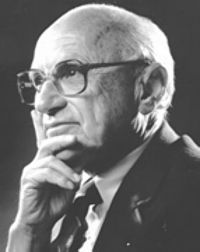
Milton Friedman: 1912-2006


It is never an easy thing when someone that you admire dies. It gives rise to myriad different feelings: appreciation for their inspiration, sadness for the loss of their presence and reflection on their legacy, to name but a few.

These were my feelings in part when I learned of the death of Milton Friedman. Dr. Friedman died at the age of 94 at his home in San Fransisco. Here is the press release from the University of Chicago, with links to other news stories on Friedman's death.

It is easy with a person like Milton Friedman to chalk up all of the accolades. Winner of the 1976 Nobel Prize in Economics. Co-Founder of the Chicago School of Economics. Advisor to leaders around the world from Great Britain and the United States to China and the former Eastern Bloc. Author of tens of books and hundreds of articles on every topic from money supply to school choice, from narcotics policy to consumption, from taxes to military conscription.

It is also easy to point to the changes that a person like Milton Friedman caused in thinking and policy. Countering the Keynesians, Friedman asserted that aggregate demand in an economy does not indeed fall with rising economic fortunes. In other words, Friedman presents a convincing argument that people do not save more when they make more and that demand rises regardless of the overall fortunes of a given economic system. He also famously argued that inflation precedes, rather than follows, changes in the overall economy. This argument, if general trends in the economy are considered, turned out to be spot on. To remedy this, he proposed what became known as the monetarist theory of money supply, which calls for control of money supply which in turn controls large-scale economic factors. Again, this proved to be nothing short of prophetic in its simplicity.

It is also easy, in pursuing these aformentioned easy tasks, to forget the larger implications of Friedman's thought and concept of economics and society. Yet it is in this field where he has been, in my mind, the most profound.

Milton Friedman saw society not in terms of the collective, but in terms of individuals. These individuals are free actors, or they should be: there is often much that stands in their way. Road blocks to the free exercise of human desire and will are erected by the artificial states that claim power over the lives of people. In an attempt to secure their power, they play the role of parent, schoolmaster and policeman, trying to limit the ability of the individual to act as they deem best for their interests.

What arises from such socioeconomic limits? An inherently unfree society that holds the synthetic state in higher esteem than the natural rights of the individual. Governments can only exist if they hold coercive power over the mass of people that they govern; this power is rarely exercised with the best interests of the individual in mind because they run counter to the inherently paranoid nature of state power. In other words, most states as they are could not handle a society of individuals completely free to choose their destiny.

Yet this is perhaps the only societal arrangement where the full rights and dignity of human beings can be protected and exercised. Friedman was not an anarchist, nor am I. The only purpose of the state is to provide a deterrent for those who would infringe on the rights of others. This small enforcement power, excepting all else, is the only proper function for the state. It is not regulation, enforced morality, prohibition, coercion or intrusion. The state should be the servant of the individual, not the master.

Friedman was an unabashed optimist, and so am I. He believed that people are smarter, better informed and at their core more attuned to their desires than any state ever could be. He believed that a society of free people would be not only orderly but humane. I believe this too, and it is through no small contribution of Milton Friedman.

Can we ever live in the world that Friedman envisioned? I certainly hope so, because that is the world in which I want to live. Wouldn't you? We would all do well to understand Milton Friedman and his legacy, for he believed in us to build a more free (and therefore just) society.

Thanks, Dr. Friedman. You helped to show us the way.

Will we be brave enough to take it?

Wednesday, November 08, 2006

Rumsfeld Out? No Big Shock Here.

This news, while doubtless important, was not really shocking in the least.

The pack has been baying for Rumsfeld's blood for quite some time now. Why, just two days ago, the various publications of the armed forces themselves called for Rumsfeld to go.

This added to the voices that had already been calling for the (for lack of a stronger word) embattled Secretary of Defense to go.

Will there be more shake-ups in the cabinet? Most likely yes, and some of them will not be at the president's behest. With a hostile Congress and time ticking down, many cabinet members will be looking to do some political "profit-taking," getting those cherry lobbying, lecturing, and consultant jobs that doubtlessly await departing cabinet members.

Just think about how many cabinet members left in the second terms of both Ronald Reagan and Bill Clinton.

They don't want to go down with the ship when there is a golden life preserver waiting for them on K Street or a university political science department (or sometimes both).

Would you?

I Should Have Had Money On This

Well, I didn't do too bad at all at calling the elections last night. Let's see somewhat of a statistical shake-out...

Gubernatorial Races
Total Predictions Made: 33
Total Correct Predictions: 32
Incorrect Prediction: MN (Maybe Hatch's "Republican Whore" slip wasn't nothing...)
Percentage of Accuracy: 96.97%

Senate Races
Total Predictions Made: 32
Total Correct Predictions: 31
Incorrect Prediction: VA (This race is still close as of Wednesday afternoon...I smell recount...stupid "macaca" factor).
Percentage of Accuracy: 96.86%

We'll have to see about Virginia in the coming days. In a political climate where recounts are almost de rigeur, it is not far-fetched that this resuly may change.

Yes, it is perfectly normal to feel incredibly impressed.

Monday, November 06, 2006

Election Eve Special: U.S. House and Other Races

It would just be silly to predict all of the elections for the House, but I do offer this observation. If a rising tide lifts all boats, then a tidal wave lifts them across land masses.

Where did this "Democratic tide" come from, exactly? I suspect that it is a sentiment of "anyone but Bush" and people figure that voting for the other group of buffoons will make things better...right?

The truth is that I am not sure I believe all of this. It seems to me that our foci need to be elsewhere than picking someone we've never met to do a job we don't understand for money we don't control in a city far away. Sounds like trouble to me...

As for Wisconsin ballot measures: the marriage amendment will sadly pass. This, striking another blow against freedom of choice and the right of gays to be free is embarassing and I hope that I am wrong on this one. As for the death penalty thinggummy, it hardly matters as it is an advisory referendum, but expect it to pass.

Now, get beer, watch TV and see the monkeys dance tomorrow night...

Election Eve Special: Gubernatorial Races

Now, for the state houses...

Incumbent Republican Governors WHO Will Be Re-Elected
Riley-AL (CM)
Schwarzenegger-CA (BB)
Rell-CT (LS)
Perdue-GA (CM)
Lingle-HI (LS)
Heineman-NE (LS)
Carcieri-RI (CM)
Sanford-SC (LS)
Rounds-SD (LS)
Perry-TX (BB...Perry is not popular and has faces serious independent opposition...like Kinky Friedman - Go Kinkster!)
Douglas-VT (CM)

Incumbent Democratic Governors Who Will Be Re-Elected
Napolitano-AZ (LS)
Blagojevich-IL (CM...Blago is months away from trouble...just not now)
Sebellus-KS (CM)
Baldacci-ME (CM)
Granholm-MI (CM)
Lynch-NH (LS)
Richardson-NM (LS)
Henry-OK (LS)
Kulongoski-OR (CM)
Rendell-PA (LS)
Bredesen-TN (CM)
Doyle-WI (BB...I think it will be closer than Doyle would want, but...)
Freudenthal-WY (CM)

Incumbents Who Will Be Unseated (With Opponents)
Maryland- O'Malley (D) def. ERLICH (R) (BB)
Minnesota- Hatch (D) def. PAWLENTY (R) (RT)

Open Seats
Alaska- Palin (D) def. Knowles (R) (CM...maybe)
Arkansas- Beebe (D) def. Hutchinson (R) (BB)
Colorado- Ritter (D) def. Beauprez (R) (CM)
Florida- Crist (R) def. Davis (D) (CM)
Iowa- Culver (D) def. Nussle (CM...weak)
Massachusetts- Patrick (D) def. Healey (R) (CM)
Ohio- Strickland (D) def. Blackwell (R) (CM)

Election Eve Special: U.S. Senate

Here are my calls for the Senate races up for election tomorrow:

Incumbent Republican Senators Who Will Be Re-Elected
Lott-MS (LS)
Kyl-AZ (CM)
Lugar-IN (LS-He is running unopposed...yep.)
Snowe-ME (LS)
Ensign-NV (LS)
Hutchinson-TX (LS)
Hatch-UT (LS)
Allen-VA (RT...actually, razor thin is hardly the word for this call.)
Thomas-WY (LS)

Incumbent Democratic Senators Who Will Be Re-Elected
Feinstein-CA (LS)
Lieberman-CT (CM...I know that he is an independent technically, but, c'mon...)
Carper-DE (LS)
Nelson-FL (LS)
Akaka-HI (LS)
Kennnedy-MA (LS)
Stabenow-MI (CM)
Nelson-NE (LS)
Menendez-NJ (RT)
Bingaman-NM (LS)
Clinton-NY (LS)
Conrad-ND (LS)
Sanders-VT (LS)
Cantwell-WA (LS)
Byrd-WV (LS)
Kohl-WI (LS)

Incumbents That Will Be Unseated (With Opponents)
Missouri - McCaskill (D) def. TALENT (R) (RT...almost too close to call)
Ohio - Brown (D) def. DEWINE (R) (CM)
Pennsylvania - Casey (D) def. SANTORUM (R) (CM)
Rhode Island - Whitehouse (D) def. CHAFEE (R) (CM)

Open Seats
Maryland - Cardin (D) def. Steele (R) (RT)
Minnesota - Klobuchar (D) def. Kennedy (R) (CM)
Tennessee - Corker (R) def. Ford (D) (RT...again, almost too close to call)

Election Eve Special: A Note On Abbreviations

Just to let you know, here are the abbreviations and such that I will use in the above predictions:

STATES: States are denoted using their two letter postal code abbreviation.

PARTIES: "R" is for Republican, "D" is for Democrat...unfortunately, that's about it.

INCUMBENTS: denoted in CAPITAL LETTERS

CONFIDENCE OF PICK: This is based somewhat on polls, somewhat on news and mostly on my prejudices and hunches in looking at races from the outside. LS=Land Slide (I am 50% confident in my choice or higher); CM=Comfortable Margin (I am between 49% and 25% confident); BB=Barn Burner (I am between 24% and 10% confident in my choice); RT=Razor Thin (I am between 9% and 1% sure on these).

I think that does it.

Ready to enter the depths of punditry hell? Let's ride...

Sunday, November 05, 2006

Happenstance, I Know. Still...

I, for one, thought that this was great. It is a random generator to determine what the movie of one's life story would be called and the director.

QuizGalaxy.com!


Take'>http://www.quizgalaxy.com/quiz.php?id=68">Take this quiz at QuizGalaxy.com


I will have something real (or as real as elections get anymore) tomorrow.

Friday, October 20, 2006

Clank Your Chains and Count Your Change, Try And Walk The Line

On my best days, I like to believe in the ultimate ability of the human race to get it all right in the end. I like to side with the philosophy that people are inherently good, possessed of reason and the ability to govern themselves and their societies in a manner that, while not completely perfect, speaks to the "better angels of our nature." Abraham Lincoln said that last bit, in his first inaugural address on March 4, 1861. It seems that Lincoln believed in the ability of people to aspire to their best not only in governance, but in society. He was, after all, the president that weathered the American Civil War and gave Americans their "new birth of freedom."

On my worse days, and an extended Lincoln analogy is useful here, I think of the other side of the man who coined the above famous seeming endorsements of the power of people to positively govern themselves. There is much that can be said to suggest that Lincoln is not as he is commonly remembered. He suspended the writ of habeas corpus, had a rather checkered record when it came to "enemy combattants," and it is all but certain that the Northern States did not primarily enter the American Civil War to end slavery. Read more about the other side of Lincoln here.

Therein lies the problems I currently wrestle with concerning the nature of humankind and the issue of political organization. On one hand, I stand firmly with Locke, Montesquieu and Nozick in thinking that people, with their essential liberty, will naturally have their best interests (and therefore the best interests of others) in mind at all times. Self-interest leads to public benefits by encouraging enterprise and a healthy respect for the rights of others to do the same. It's too bad no-one reads Bernard de Mandeville anymore; he had a point with all his talk about bees.

This side of my thinking, therefore, believes that people (and the societies to which they belong) can, given an emphasis on the individual and their inherent rights, can be a force for good and that political systems can indeed be moral and ethical. From good people and their good actions should come good societies. Yay, Aristotle!

Then, there are those other days...

There are times when it seems like people will never get it right. Concerned with themselves and gain at the expense of the freedom and right of others, people seem inherently evil. The systems of which they are a part, moreover, seem to reveal this. Societal organizations from governments to corporations to interest groups seem bent on one thing: their agenda and damn all else. They are in the system for what they can get out of it and never mind the rights of others. It is a battle for survival and the normal state of affairs is a state of war and strife.

Who is my philosophical travelling partner on these days? Why, Thomas Hobbes, naturally. Hobbes argued that life is "nasty, brutish and short." He asserted that without a strong governing force that was not accountable to anyone, people would simply kill each other to get what they want or think they need. He also believed that politics, or at least most political systems, were inherently corrupt, immoral and fraught with bribery, duplicity and out-and-out violence. For Hobbes, politics was not a question of right and wrong, good and evil. It was a question of order and chaos and it is clear what side he came down upon.

It is not hard to see how Hobbes came to these ideas, given the times from which Leviathan emerged. His interpretation of English society in the years before the English Civil War, going back to the time of the early Tudors, exposes a world of corrupt court politics where favor and influence stand at the center of the system. Patronage was the order of the day and it is not hard to extend this, by way of Hobbes's ideas about governmental systems, through history to the present day.

Hobbes believed that, really, the system of government did not matter. Although an ardent Royalist himself, a government's form was unimportant; it was the fact that all subjected themselves to it utterly that mattered most.

In more recent times, an entire school of political history evolved around the notion that politics concerned influence-peddling to gain favor for political factions and members of parties and higher purposes be damned. This, the "Namierite" view of history (after Sir Lewis Namier and his landmark 1929 book The Structure of Politics at the Accession of George III) is a stunning comment on political systems in general and one that it is not at all far-fetched to imagine operating in our very midst.

What stemmed all of this in me, you ask? Well, when one studies politics and society in the past, it is inevitable that connections be made between human behavior in the past and that with which one is surrounded on a daily basis. More specifically, in my extensive reading into Tudor and Stuart politics, it occurred to me that political operators like Thomas Wolsey, Thomas Cromwell, John Russell, William Cecil, Robert Devereaux, Francis Walsingham and others would have been right at home in the Chicago of Mayor Richard J. Daley.

These courtly Tudor Englishmen of the sixteenth and early seventeenth centuries would have fit right in with the ward-heelers and machine politicians of mid-twentieth century Chicago. They would have, come to think of it, fit right in in most eras of Chicago politics. I can see Wolsey and Cromwell getting along famously with John "Bathhouse" Coughlin and Mike "Hinky Dink" Kenna, the "Lords of the Levee." The boss? In one case it was Henry VIII, in the other it was (mostly) Chicago Mayors Carter Harrison, II and William Hale "Big Bill" Thompson.

New wine in old bottles, indeed.

So, what do I think about politics and people? I guess one might say it depends, as I have shown above. I would like to think that people will always, by doing what is right for themselves, also look out for the interests of others. History, however, provides many examples of people doing the exact opposite.

So, whether we clank our chains or count our change, it still depends what line we choose to walk. Robert Hunter's words outline the dichotomy at play here.

In closing, I invoke the immortal words of Bertrand Russell:

"It has been said that man is a rational animal. All my life I have been searching for evidence which could support this."

Wednesday, October 11, 2006

If You Hate It That Much, Move.

Living in a middle-sized Middle American city is, on balance, a great thing. You have all of the modern convienences of the city and you are not more than a twenty minute drive from, in my case, the gently rolling hills of south central Wisconsin. If you get the itch for the big city, Chicago is a hop, skip and a tollway away and Milwaukee, Madison's bigger brother, is only an hour down the road.

The real draw, and the reason that I think the Midwest is the best, is us, the Midwesterners ourselves. It is hard for me to do this, for one of the traits of our sort is modesty, but here goes.

You will not find more friendly, open, honest and genuine people than in the Midwest. Period.

We are always glad to see you, welcome all and are always ready to share whatever we have with friend and newcomer alike. We are proud of our cities, our towns and farmlands. Sure, there are differences between parts of the Midwest, and friendly rivalry between its component parts, but at the end of the day, it is no mistake why this is called "the heartland of America."

Take the Saturday afternoon I enjoyed last week. Breakfast with friends before heading to Camp Randall Stadium to watch the Badgers play Northwestern. An absolutely ideal fall afternoon with the leaves falling and the sun making one last hurrah even as the wind reminded all that the changing of the seasons was upon us. Afterward, pitchers of Blatz beer and conversation topped off with prime rib at the supper club and more good talk and friendliness. What could be better? Not much, if you ask me.

You see, we know that we are not the "coasts," and we like it that way. A lot of educated people sneer at the idea of coastal elitism, but it is a real thing and Midwesterners (and Southerners) feel it all the time. That is part of my reason for writing this.

As a graduate student at a large public university, I am constantly in contact with people from all over the country and all over the world. It is fascinating to see how different people, especially from "the coasts" react to moving to the Midwest. For other Midwesterners, it is like moving but not really. Not so for others, and this is where the elitism comes in.

These sorts of people cannot get it through their heads that things here will never be like they are in Boston or New York or Los Angeles. Ever. What's more, we are happy about this and will fight tooth and nail to keep it that way. Alas, the more we Midwesterners try and welcome these newcomers in our open and friendly manner, they refuse and push back and will not immerse themselves in the culture of their new home.

The accusations and stereotypes are easy enough to recount. All Midwesterners are: hicks, bigots, ignorant, small-minded, fat, crude, beer-soaked buffoons who just do not get it. We Midwesterners would be utterly lost in anything approaching REAL civilization and what we hold dear as the components of our way of life are but laughable shadows of a real culture. The food is terrible, the weather is worse and overall, if everything west of the Appalachians and east of Las Vegas were to vaporize tomorrow, that would be better off for the whole county.

Yep, I'm sure you have heard it all before.

With many of my colleagues, I am running out of answers or witty comebacks to defend my Midwestern home region. I am not sure what to say anymore. So, here is the ultimatum:

Either stop judging, open youself up to us and our ways and maybe, just mabye, allow yourself to be seduced by our charms or leave tomorrow. Simple as that.

If it is indeed so much better where you come from, don't let a measly job or academic appointment here in Dogpatch keep you here. You must have better schools where you come from, right? I mean, you can't take a piss in Boston without hitting a college or its students and UC-Santa Barbara is on the ocean. There must be something there for you, right?

Meanwhile, we will continue to enjoy football in the fall, bratwursts, small towns, manageable cities and most of all each other. The people are really, to again quote Lord Buckley, the flowers of life and we sure do enjoy our garden of life here.

If you cannot see us for the plain and honest people that we are, well, that's really a shame. We tried and tried. What more can we do?

Well, I would be glad to offer you bus fare to the airport. Make sure to just buy a one-way, O.K.?

Wednesday, October 04, 2006

Going From Worse To Catastrophic?

I had planned to post my big pre-election prognostications, but there may be some changes due to, surprise here, current events.

I am sure that, unless you have been in a coma or undersea or something, that you have heard of the sordid tale of former Congressman Mark Foley (R-FL).

Now, as in any politicomedia scandal, the fallout is spreading. There have been calls for Speaker of the House Dennis Hastert (R-IL) to resign because he may have known about the alleged abuse as long as a year ago. This touches other members of the Republican majority in the House, such as Rep. Thomas Reynolds (R-NY), who may be implicated in a cover-up of Foley's alleged disgusting behavior. Others in "backpedal" mode because of alleged knowledge and a possible cover-up are Reps. John Boehner (R-OH), who is the House Majority Leader, and John Shimkus (R-IL), who oversaw the page program when Foley was, ahem, active with it.

Naturally, this is all made more interesting in an eletion year, especially one when there has been so much talk about the G.O.P. losing ground and the chance of them losing the twelve year hold they have had on the legislature.

What do I think of the whole thing? First off, no-one should ever make light of an adult making untoward advances on a minor. Ever. Secondly, Foley's hypocrisy exceeds even that of most pols with his record of legislation to protect children from predators. His claims, thirdly, made all at the same time that he is gay, was molested by a clergman and is an alcoholic seem like a whole bunch to admit at once.

Realizing that one is homosexual does not happen all at once, nor does it help to explain alleged sexual advances on children. Having been molested as a child is a grave tragedy, but one that seems to have been revealed at just the right time. Also, I don't buy for a second the "I was drunk" defense. I have tried it to get out of stuff that was, well, not a felony and it never works. Seems that some of Foley's colleagues think so too.

Should Dennis Hastert be forced/compelled to resign? I think not right now. Why, if he knew? First, nothing has been proven, no-one has been charged and the speculation is so deep you could fish for marlin in it. It has been clear for a while that the House G.O.P leadership needed a change after things like the Jack Abramoff ordeal and the bribery scandals of Bob Ney (R-OH) and Randy "Duke" Cunningham (R-CA). Clearly, a change is needed.

Why not now? With the real possibility of the G.O.P. losing its hold on the House, the problem might just take care of itself. Different sorts of leadership are needed in oppositon than in majority and Hastert and Boehner (who himself took over for the disgraced Tom DeLay) might not be the guys for the job. My advice: wait until after the election is over and go from there.

Will the Foley ordeal be seen as the last nail in the G.O.P Congressional coffin? Things looked bad before and, in my opinion, this cannot be helping them get any better. This midterm election will be a headhunt against incumbents, as people seem to be losing confidence in their leadership. This effects the G.O.P. more because, well, there are more of them. Seeing as people are not willing to look beyond the two-party system and see that there are other options, they will vote for "the other guy."

Will this keep the so-called "values voters" (read Christian fundamentalists) away from the polls in November? Here again, Foley cannot be helping in any way garner the megachurch, creepy evangelical crowd. Voters are so flaky when it comes to turning out, though, so who can say? Foley is a sufficient condition of a G.O.P. downfall, not a necessary one.

Will a Democratic Congress make it all better? Now, let's not be silly.

Would you really feel any better in knowing that a different group of lunatics is running the asylum?

Wednesday, September 27, 2006

Old Farts Or New Pols? Your Choice.

Two entries today. One about new British politics, one about old British fart jokes.

What stinks more: farts or electoral politics (or my commentary on either)?

Maybe don't answer that last one.

Enjoy (I hope).

Blair's Swan Song And The Road Ahead

Before turning to elections over our way, I thought it may be interesting to dirty our collective hands on the electoral situation that is developing in the U.K. No, it is not yet time for a general election, but the waters are churning even before the end of the 2006 Labour Party Conference in Manchester.

Labour Party Conference '06: Blair Out: Brown In?

Everyone and their aunt knew that when Tony Blair and the Labour Party (LP) won the last general election last year, the leader of that party and Prime Minister (PM) since 1997 would step down before another election was called. You see, in the UK, elections are not necessarily held on the rigid, every-four (or two)-year schedule as here.

The PM decides when to call a general election based on the political mood of the party, the nation or (usually) for means of political expediency. By law, however, there must be a general election (meaning all 635 seats in the House of Commons) at least once every five years. Blair has been the PM for almost ten years and he wanted to give his successor a decent run-up to the next general election, which will most likely be in 2009 or 2010 (probably).

By means of a short explanation (for those of you who don't know), the British party system is also a bit different than ours in that the leader of the party carries a lot more weight over there than here. In fact, it is usually the leader of the party who becomes that parties incumbent (or candidate) for PM. All of this was in flux during the LP's Party Conference this year (a party conference is much like a political party convention in the U.S.)

Of course, there were the speeches by the now somewhat lame-duck Blair. You know the sort of thing: reflect on the legacy, forging a new and better Britain and world for the kids, regret differences with opponents. Read a summary of Blair's version in his farewell to the party here. If you don't want to read it, just think of the lyrics to the song "My Way," and you get the idea.

There was also a speech given by our very own ex-president Bill "I Really Tried To Get Osama" Clinton. Apparently, the Bill Clinton Admiration Society did not have a meeting this week and he was free to speak in Manchester. All joking aside, I agree with the commentary in the Manchester Guardian in that Clinton's liberal standing and manner, coupled with his image (on the rise, given the current president's woes), was just what the LP conference needed. Clinton reminded the crowd not to take their out-going leader for granted, to look to the future and keep policy at the forefront...

The Battle for LP Leadership: Phase One

...which is often hard in the personality-driven scramble for the party leadership which will last from now until Blair steps down and then until the next general election. The heir-apparent, for some time now, has been current Chancellor of the Exchequer Gordon Brown. He has been the Chancellor since 1997 and has received mixed reviews on his performance, seeing unemployment drop and the economy generally rise, but saddling the government with new debts. What has been the more contentious issue is a long-term personality clash between Blair and Brown.

Blair, like his hero Bill Clinton, came on to a political nation in turmoil. In 1997, the Conservative Party (Tories) had been in control of the government since 1979. Under Margaret Thatcher (1979-1990), the UK had generally done well economically and unemployment had gotten better than it had been under LP governments in the 1960's and 1970's (which is not saying much). Under Thatcher's successor, John Major, things got appreciably worse. Inflation spiked, unemployment reared its ugly head and problems continued (as ever) in Northern Ireland. Blair, when he seized the leadership of the LP in 1994, he aggressively set about reforming his party's image and game-plan.

The LP, in the Thatcher and Major years, had been pretty firmly in the control of what came to be known as "Old Labour," or less complimentarily the "Looney Left." These were a smattering of old leftists, socialists, communists and other bits and pieces of previous regimes whose fractiousness helped lead to Thatcher's initial victory in 1979. Blair sought to purge the party of these elements and remake the LP into a modern, social-democratic party. In that, and the birth of "New Labour," he was quite successful, winning the 1997 general election and two more after that.

Gordon Brown, who has been with Blair from the start, is really none of those things that made Blair so popular. He is not charismatic or even terribly at home in front of the press. He made his reputation as a tough policy man, working in the Treasury to implement the changes that made Britain prosper again in the late 1990's and into the 21st century. He has also been the heir-apparent since at least just before the 2003 general election if not more. One could see how the two could conflict and how Brown could have a different leadership style and policy agenda than Blair.

This, naturally, leads to speculation about...

Is Brown The Man?

Here is where my opinion comes into play. Gordon Brown, unless he makes really bad mistakes or decides to piss the boss off in his last months, will be the choice to succeed Blair as PM. That being said, one must account for the fact that the press and public in the UK don't necessarily like being presented with a political fait accompli.

This means BECAUSE Brown is the front-runner now, he might not get it. Counterintuitive? Yes, but this is, after all, the squalid politics of personality. In that light, read the excellent commentary in the Times by former Tory Opposition Leader Michael Portillo on the "death of policy" in British politics and the somewhat undue focus on personality (oh, if we could ever deal with this one...).

So, who, then? Could be any one of a half a dozen or more. Take a look at the possible list of challengers from Blair's Cabinet (and party at large) and their respective claims/chances. Challengers for the leadership of a British political party usually come from the ranks of the Cabinet (in the case of the Government party) and the Shadow Cabinet (in the case of the Opposition).

From what I have seen, the ones to keep and eye on are current Home Secretary John Reid, who has held top positions in government, has a no-nonsense approach to tough policy decisions and is often seen as one of Blair's closest confidants and hatchet men. Look to Reid to be a favorite among those who are ardent Blairites and the "anyone but Gordon Brown" choice. Also not to be ignored is current Education Secretary Alan Johnson, who's star has been on the rise for some time and his promotion to Education this summer made him a real challenger. Also among my three possibles is current Northern Ireland Secretary Peter Hain, who has made no bones about the fact that he wants to be in LP leadership and will stake his reputation (which is quite good) to get it.

Other less likely candidates can be seen in the aforementioned summary. For future watchers, keep an eye on Jon Cruddas and David Miliband - they are the next generation, as it were.

The Conservatives: Their Game Plan

The Tories with their (relatively) new leader David Cameron, MP (Witney) are, naturally, keeping an eye on the whole affair, most especially I imagine the rift in the leadership and a possible challenge. What they might even want more is for Brown to get the leadership, cause a rift in the LP and face the next general election against a split and rancorous LP. I am sure there is nothing they want more.

Until then, Cameron and the Tories will continue to press their agenda of change from the Blair orthodoxy, a possible reordering of foreign policy and maybe even different steps in the relationship of the Union and the U.K. to the European Union. This is all leading to their party conference next weekend (10/1-10/4) in Bournemouth. It will be interesting to see what emerges.

The Liberal-Democrats: The Tipping Point?

Lastly, one must consider Britain's "other" party, the Liberal-Democrats (Lib-Dems), in the equation. With the LP split and the Tories trying to capitalize, the Lib-Dems might be the hinge in the next general election. With their reconfirmed leader in the person of Sir Menzies Campbell and their "damn all" approach to the LP and the Tories, the party has a real chance...that is if they can woo middle class swing voters in London and the Home Counties to leave Labour or Conservatives and go their way. Here is a good piece of commentary by Matthew Parris in the Times about a possible winning strategy for "Ming" Campbell and the Lib Dems.

So What?

I know, a pretty long piece about the government of somewhere else. It interests me, though, and I think that as (for better or worse) our "special relationship" remains, what happens in the U.K. matters here.

Or not. Up to you, really.

Jacobean Fart Jokes


I, for one, find this poem hilarious.

Ben Franklin loved a good fart joke, too.

As I have always said, it never gets old.

Ever.

Thursday, September 21, 2006

Like A Ton Of Intellectual Bricks

Yes, I am fully aware that I have not posted in some time. The academic year, coupled with personal commitments, have drained my time to the last.

I know I promised reflections on my first year in Madison and "Swinging London," so here goes:
  • Madison feels more like home every day...and Oak Forest, apart from my family being there, feels ever less so. It is somewhere I am "from" not "of," if you follow me.
  • London, and all of England, was a mostly joyful and happy place in the early 1660's. Remember people in Afghanistan when the Taliban was deposed. Same deal. It didn't last.

Now, as to the future, we are in the midst of an election season and, as you all know, electoral politics is one of my drugs of choice. I will, naturally, offer my views. In fact, I will post tomorrow with some predictions.

If all goes according to plan. I hope. Probably.

Thanks for your continued support.