Wednesday, December 10, 2008

Political Crisis...In Canada?

Yes, you read the title right.

Probably had to look twice, though, didn't you?

It's just that those two ideas rarely appear together.

In the last few weeks, though, they have with some frequency.

You may have heard something about this. That is, you may have heard of it if you keep up with international news or happen to be Canadian. It is an interesting story nonetheless and one worthy of our attention.

A bit of background about the Canadian government might help clear things up. Canada's government is a parliamentary system very similar to the one in the United Kingdom (and many dominions and former colonies of the British as well as this map shows).

In systems such as the one in Canada, the "government" actually refers to the party with the most seats (most Members of Parliament or MPs) in the lower house of the Parliament. Canada's Parliament is composed of two houses, the Senate and the House of Commons and the Sovereign as represented by the Governor-General (more on this below). The Senate is largely appointed and need not concern us here.

One appointed official who DOES concern us here is the Governor-General. The Governor-General is an appointed representative of the head of state in Canada, who just happens to be this lady. The role of the Governor-General is largely ceremonial (as is the role of the Queen in Canada). One duty that is often just ceremonial is the calling and dissolving of parliament.

Now, in a parliamentary system, elections don't just happen every four years. What happens is that there is usually a time limit (which is five years in Canada) for any government in which they must call a general election. In Canada, they just held a general election on October 14 of this year. Read about it here. Before this can happen, though, the prime minister, who is currently Stephen Harper of Canada's Conservative Party must ask the Governor-General to dissolve the House of Commons and call for an election.

O.K., you say, that's great. Canada has a fascinating and British-esque form of government. "Where's the crisis you promised?" you ask, with a mixture of mild annoyance and strong boredom. Well, here it comes.

In the last election, Harper and the Conservatives didn't get a majority in the House of Commons. What this means is that they didn't win in enough ridings to gain complete control of the government. This leads to what is called a minority government, which often happens in systems where though two parties may dominate, there are other serious contenders for the votes of the electorate. In Canada, the two dominant parties are the Conservatives and the Liberals. The other parties that are represented in the House of Commons are the New Democratic Party, Bloc Quebecois and the Green Party.

Now, in a minority government, the party with a plurality forms the government, but the position of this government is never very secure because of the possibility of something called a no-confidence vote. A no-confidence vote is proposed in Parliament by the opposition to the government in an attempt to weaken a government or, in some cases, cause its downfall. If a government loses a no-confidence vote, it usually has to resign or call for a dissolution of parliament and a general election.

Back to our situation...it seems that Harper was on the verge of facing a no-confidence vote in the House of Commons. Instead of going through the vote, which it seems that Harper and the Conservatives figured they'd lose, Harper went to the Governor-General and asked that Parliament be prorogued. The Governor-General agreed.

Prorogued? What the hell does that mean? It means to suspend Parliament without dissolving it (and thus needing to call new elections). The power to prorogue the Parliament in Canada rests with the Governor-General. The power to ask for Parliament to be prorogued, furthermore, rests with the current Prime Minister.

What has come of this situation? Well, the Liberals have had a leadership change to professor-cum-politician Michael Ignatieff. What this will mean for the party going forward is anyone's guess, but he seems to be a bit stronger of a personality than former head Stephane Dion.

The intervening month, observed a Canadian friend of mine, will give a chance for some heads to cool and others to roll, as they already have. I suspect he is right.

(ADDENDUM: Why did I write all of this? First, I think political dynamics in parliamentary systems are interesting. Second, it is fun to talk about anything approaching political crisis when it involves a usually placid place like Canada. Third, I hadn't written a long post about a political situation in a non-sexy foreign country in a while. I'll bet you're glad THAT drought is over.)

Friday, December 05, 2008

Celebrate Repeal Day! Drink Alcohol Today!

Today we celebrate a great moment in our national history. A day when it was realized that morality cannot be legislated without disasterous consequences. A day when a nation reeling from economic depression was at last given a (legal) release valve. A day when the forces of the nanny state were sent packing, or at least for a while.

For on this day seventy-five years ago, December 5, 1933, the Twenty-First Amendment was ratified, repealing the provisions of the Eighteenth Amendment. Our nation's dark period of Prohibition had ended. Americans could legally drink again.

HAPPY DAYS ARE HERE AGAIN!

Repeal Day, though always important to us in the drinking community, has languished as a broader national commemoration. This website, started by a bartender in Oregon, is a step to remedy that. More needs to be done, though.

Why was alcohol prohibition tried in the first place? It was a strange marriage between Progressives and Christian Evangelicals and others. Centrally, though, the Progressives thought that mankind could be made better if alcohol was unavailable. Evangelicals believed that alcohol was the root of what they saw as the moral degridation of humanity. Alcohol caused people to do wrong. God does not want us to do wrong. Alcohol, therefore, is an abomination of God. That is rather simplified, but you get the idea.

What did Prohibition accomplish? Well, a lot. A lot, however, that its supporters didn't expect. Click here for a great overview of the effects on Prohibition on crime, health, demand and prices. Generally, though, crime rose instead of fell, more people died of alcohol-related causes rather than less, demand and prices both increased (this rarely happens in a free market). Oh, and it gave rise to organized crime and all the spending and manpower needed to "fight" it. Click here for more on that aspect.

How did it get repealed? It became clearer and clearer to the American people that the Eighteenth Amendment was doing more harm than good. Women were espcially critical here. Just having been given the vote in 1920, women flexed their political muscle for repeal. People like Pauline Sabin and her Women's Organization for National Prohibition Reform were important in the groundswell for repeal.

Franklin D. Roosevelt and the Democrats ran with a Prohibition repeal plank in their 1932 platform. By "election season" in 1932, most Americans were ready to see Prohibition behind them and for this (and other reasons, naturally) FDR and the Democrats won in 1932.

It was on December 6, 1932 that Senator John J. Blaine of Wisconsin (we are really proud of this here), submitted a resolution to Congress proposing the submission to the states of the Twenty-First Amendment to the U.S. Constitution. It was finally ratified by the thirty-seventh state (Maine) seventy-five years ago today.

How should we celebrate? Purchase and consume alcohol. Simple as that. It can be a case of beer with your buddies, cocktails with your significant other or a bottle of scotch by yourself. It does not matter. Do it because you can. Do it because our forebears saw the error of social engineering and trying to limit the freedom of people to ingest anything they damn well please.

So, the idea of prohibition is ancient history, right? Wrong. I won't go into this at length here, but we still prohibit free individuals from access to certain substance. I am talking about what are now considered "illegal drugs." Read this interesting research report from the Cato Institute on the relation between alcohol and drug prohibition.

Where can I learn more? Click here for a great website at SUNY-Albany on the "Great Experiment," its times and (thankfully) its downfall.

CHEERS!

Tuesday, December 02, 2008

Celebrate Liberty...Dress Like A Slob

(NB: This post was partially inspired by my first-and last-exposure to this television show. There was a marathon on, my bad ankle was acting up and the remote was across the room. I finally get around cable and this is what happens. It also has a lot of things that I have been thinking about for some time)

I have often heard it said that everyone develops their own sense of "style." I have never been sure what to make of this rather nebulous term. In other words, I do not know really what style means to me or to others.

I, furthermore, do not see my self really ever caring about this. If pressed with the question, "what sort of look were you going for there?," I would really not know what to say. I usually have some smart-assed remark ready to hurl like "annoyed middle-manager of a moderately successful mid-level corporation" or "annoyed mid-level bureaucrat in a non-sexy government department."

So, why do I dress the way that I do? Mostly practical concerns. I want to hide my nakedness (believe me, the world wants NO part of that). I am, at present and for some time now, usually stony broke. I have to comply with some vague, non-specified dress code for whatever job I have.

Do I care at all what my clothes look like? Well, yes and no. I want them to be clean and in reasonable repair. As for color, I shy away from anything bright or attention-getting. Frankly, if they sold buttoned-down collar shirts (in any pattern or sensible color) in a roll like paper towels, I would buy them in a second.

Why then, Will, are you writing about this? It comes from a connundrum that I had upon viewing the above-bookmarked television show.

On one hand, I believe that people should be able to spend their money on whatever consumer goods strike their fancy. This is why markets are the best and most fair way to allocate resources. People, making their individual decisions for selfish reasons, end up fulfilling the desires of all concerned. Sound familiar? It should.

On the other hand, and quite differently, I felt myself feeling that pursuing some sense of a "current style" went against the fundamental freedom of all people to allocate their resources as they see fit. In the past there were sumptuary laws that limited access to certain forms of consumption. The only barrier to individual consumption, the only fair barrier anyway, should be prices set in free and open markets.

Another source of my qualms has been some notion that people in other countries (particularly European ones) are thought (by themselves and us) to be "better dressers" than Americans. This is perhaps not the place to speculate on this score, but I would figure that this is a subset of the argument that Americans care about quantity over quality, breadth over depth and practicality over fashion. I am not sure why I felt this way, but I did and somewhat still do.

Why is this? I think it comes from the mere fact that in saying that someone looks "better" dressed a certain way, it makes a value judgement on that person's resource allocation decisions. It also makes a value judgement on the right of that individual to do exactly as he or she likes as long as that action does not harm other people.

I am not comfortable with either of these value judgements. If you want to spend all (or most or some) of your money on expensive garments, fine. Just don't judge me because I choose to allocate my scarce resources in a different manner. Don't hurl the epithet "slob" at me because I look like a pile of laundry with shoes under it. Just know that I make different decisions about opportunity cost. Don't make the call that, because I don't fit some certain mold of looking "put-together," that I am somehow defective in other ways.

The fundamental issue here is, therefore, that when value judgements enter decisions of resource allocation, problems arise.

What I am driving at, in the end, is that people should dress however the hell they damned well please. If that is a suit that costs what I make in a month, fine. If it is cut-off sweat pants and a BBQ sauce stained NASCAR shirt, fine. Anywhere in-between these gross stereotypes, fine.

But Will, you protest, what about decorum and dress in certain situations. I do realize that certain situations seem to call for certain modes of dress. Employers, schools, restaurants, cultural attractions and others have dress codes that must be followed or punishments can be meted out.

We must ask ourselves, though, why does it "seem" that these situations "call" for certain modes of covering one's nakedness? Why, furthermore, do dress codes exist? My short answer to both would be enforced conformity. My long answer? Perhaps for another day, that.

So, what say you, dear readers?

While you think that over, I am going to work on that "tear-off roll of shirts idea." I might be on to something there...

Tuesday, November 25, 2008

Quick And Dirty (Or Not)

Just a few news items and other things of interest:

  • More bad news from a Nobel Economics laureate. I wonder, though, if Thomas Sowell has a point here (he usually does).
  • My take on bailing out the Big Three automakers? Too bad, so sad. You had your chances to change and you blew it. Apparently, Mitt Romney and Gary Becker agree.
  • Want a good explanation of the roots of the Great Depression? Click here. Want to get it pretty much all wrong? Click here.
  • My take on Hillary Clinton as Secretary of State? Bad move, Mr. President-Elect. You will live to regret this one. Let's hope she won't make it through the Senate. Apparently, Christopher Hitchens agrees.
  • I am rapidly coming to the conclusion that this is the civil rights issue of my generation.
  • I am not sure what to make of psychology sometimes. On one hand, psychological research occasionally produces interesting conclusions based on good research. On the other, psychologists say stuff like this that make me think it is a pseudoscience.

Enjoy and have a Happy Thanksgiving.

Friday, November 21, 2008

My Eternal Gratitude

I would like to extend my sincerest, heartfelt thanks to all of you who have sent your kind thoughts and words to me and my family in this tough time.

I am still trying to come to terms with all of this. Something tells me that I never really will.

COTL will return to its regularly scheduled whining about (fill in the blank) next week. Do expect, however, that I will reflect a lot on my mom and what she meant to me and my family. I am not sure I have the words, but I sure will try. My mom always liked reading things that I wrote, and I will contiune on with all of that.

In closing, it is interesting what helps you through grief and sadness. It can be the kind words of friends, a song or the comforting feeling of familiar things. For me, this song has been much in my mind as of late. Click here to listen.

Thanks for your continued support. Goodness knows I need it right now.

Thursday, November 06, 2008

Live Blog? D.O.A., I'm Afraid.

I know, I know, I know.

I know what I said I would do. There is no need to remind me (why do people feel the need to do this, anyway)?

Yes, folks, there was no live blogging here on election night. Allow me to explain...

My reasons are twofold: practical/logistical and, well, something less practical or logistical.

Practical and logistical problems first. I shuttled between two locales on election night and was caught up in the public transit system for about a half an hour. This half an hour was at a crucial juncture in the evening, when the returns were coming in and (as it turns out) the election was being decided. I also, through no fault of my gracious hosts, didn't have access to the requisite technology to make it happen.

Other problems second. The unfolding of events on election night were, how shall I put this, rather dull. The whole thing was over and done with by around 9:30PM CST. The winner was declared, the victory seemed pretty decisive and (no surprise here) the talking heads kept on talking.

So, Will, how DID you spend the rest of the evening. Here are some sketches:
  • Red AND blue Jell-o shots.
  • Waiting for either Chris Matthews or Keith Olbermann to openly weep on air.
  • Listening to a fatter guy than myself (oh, they exist) ramble on about bingo, how cheap his fried chicken dinner was, the bus ride to bingo and how everyone from Texas is insane (I think).
  • Waiting for anyone to openly weep on television and trying to place money on this proposition. For this, I was called an asshole.
  • Missing Dan Rather and his penchant for, well, made-up idioms. I had to settle for Paul Begala saying "lights out, Cub Scout."
  • Hamm's, The Beer Born In The Land Of Sky-Blue Waters...and still represented by Norm Coleman, apparently.
  • Cheering when people DID openly weep on television. For this, I was called a heartless asshole.
  • Conjecturing that the Dow would drop at least 400 points the next day. I was pretty damned close.
  • Evan Williams Bourbon, It's What Clint Eastwood's Sweat Probably Tastes Like.
  • Listening to two of the finest political speeches that I have heard in some time. John McCain - why didn't you talk like this the whole time? It was the reason people (including myself) liked you at some point.
  • Having that feeling that I was all dressed up and had nowhere to go. In other words, I was blue-balled by the news media. Thanks for that, dickweeds.

Well, I did enjoy my evening immensely. For political hacks like myself, it is like four Super Bowls rolled into one.

What reflection on this presidential election that I will do will be short and will be soon so that we may move onto other topics including economics, Studs Terkel, Russia, UW Badgers Football (or lack thereof and others.

I leave you with a thought to ponder and a piece of advice for all of those candidates who won on Tuesday:

The state is not the society.

Monday, November 03, 2008

Shannon Makes The Call: The Presidential Race

Click here for my map of the final electoral vote count.

If you don't want to do that, here is the summary of my prognostications:

GENERAL ELECTION, 11/4/08, PRESIDENT OF THE UNITED STATES

Total Electoral Vote Counts (270 Needed To Elect)

Obama/Biden = 338 McCain/Palin = 200

Tie-Breaker

Margin of victory in Ohio = 3%.

UPDATE: Eric Andersson has pointed out that my Electoral College map is identical to that of one of the supreme political operatives, image makers and glorious dirtbags of our time. Who, you ask? Click here to find out.

I am not sure how to take this news.

Shannon Makes The Call: Senate Races

Here are my picks for what I and the aforementioned Andrew "Eric Andersson" Erickson thought were the more competitive/interesting Senate races.

NB: The winner's name appears in capital letters. The incumbent (if there is one) is marked with an "*" The party designations should be self-explanatory, as should the abbreviations for the states.

GENERAL ELECTION, 11/4/08, SELECT SENATE RACES

  • VA: WARNER (D) def. Gilmore (R)
  • NM: T. UDALL (D) def. Pearce (R)
  • AK: BEGICH (D) def. Stevens (R)*
  • CO: M. UDALL (D) def. Schaffer (R)
  • NH: SHAHEEN (D) def. Sununu (R)*
  • NC: HAGAN (D) def. Dole (R)*
  • OR: MERKELEY (D) def. Smith (R)*
  • MN: FRANKEN (D) def. Coleman (R)* and Barkley (I)
  • GA: CHAMBLISS (R)* def. Martin (D)
  • KY: MCCONNELL (R)* def. Lunsford (D)
  • MS: WICKER (R)* def. Musgrove (D)
  • LA: LANDRIEU (D)* def. Kennedy (R)
  • ME: COLLINS (R)* def. Allen (D)
  • TX: CORNYN (R)* def. Noriega (D)
  • NE: JOHANNS (R) def. Kleeb (D)

TIE-BREAKER

Margin of victory in GA Senate race = 1.5%

Shannon Makes The Call: House Races

Here are my picks for what myself and an equally astute political hack (hat tip to Andrew "Eric Andersson" Erickson) thought were interesting races in the House.

NB: The winnners' names are capitalized. The incumbent (if there is one) is marked with an "*" The party designation should be self-explanatory. In each case, the state abbreviation is followed by the particular congressional district in question.

GENERAL ELECTION, 11/4/08, SELECT HOUSE OF REPRESENTATIVES RACES

  • AL-02: LOVE (R) def. Bright (D)
  • AL-05: GRIFFITH (D) def. Parker (R)
  • AK-AL: BERKOWITZ (D) def. Young (R)*
  • AZ-03: SHADEGG (R)* def. Lord (D)
  • AZ-05: MITCHELL (D)* def. Schweikert (R)
  • AZ-08: GIFFORDS (D)* def. Bee (R)
  • CO-04: MARKEY (D) def. Musgrave (R)*
  • CT-04: HIMES (D) def. Shays (R)*
  • FL-21: MARTINEZ (D) def. L. Diaz-Balart (R)*
  • FL-25: M. DIAZ-BALART (R)* def. Garcia (D)
  • GA-08: MARSHALL (D)* def. Goddard (R)
  • IL-10: SEALS (D) def. Kirk (R)*
  • IN-03: SOUDER (R)* def. Montagano (D)
  • KS-02: BOYDA (D)* def. Jenkins (R)
  • LA-06: CAZAYOUX (D)* def. Cassidy (R)
  • MI-09: PETERS (D) def. Knollenberg (R)*
  • MN-03: MADIA (D) def. Paulsen (R)
  • MN-06: TINKLENBERG (D) def. Bachmann (R)*
  • NV-03: TITUS (D) def. Porter (R)*
  • NJ-03: ADLER (D) def. Meyers (R)
  • NM-01: HEINRICH (D) def. White (R)
  • NM-02: TEAGUE (D) def. Tinsley (R)
  • NY-29: MASSA (D) def. Kuhl (R)*
  • OH-01: DRIEHAUS (D) def. Chabot (R)*
  • WA-08: BURNER (D) def. Reichert (R)*
  • WI-08: KAGEN (D)* def. Gard (R)
  • WY-AL: Lummis (R) def. Trauner (D)

TIE-BREAKER

New Dem/GOP split in House = 267/168.

Shannon Makes The Call: Governors

Here are my picks for all of the governor's races to go off tomorrow.

NB: The winner's name is in capital letters. The incumbent (if there is one) is marked with an "*" The party designations should be self-explanatory, as should the abbreviations for the states.

GENERAL ELECTION, 11/4/08, GOVERNORS BY STATE
  • DE: MARKELL (D) def. Lee (R)
  • IN: DANIELS (R)* def. Long-Thompson (D)
  • MO: NIXON (D) def. Hulshof (R)
  • MT: SCHWEITZER (D)* def. Brown (R)
  • NH: LYNCH (D)* def. Kenney (R)
  • NC: PERDUE (D) def. McCrory (R)
  • ND: HOEVEN (R)* def. Mathern (D)
  • UT: HUNTSMAN (R)* def. Springmeyer (D)
  • VT: DOUGLAS (R)* def. Symington (D) and Mollina (I)
  • WA: GREGOIRE (D)* def. Rossi (R)
  • WV: MANCHIN (D)* def. Weeks (R)

TIE-BREAKER

Margin of victory in NC contest = 2%.

Thursday, October 30, 2008

Watch This Space

We will get back to our regularly scheduled (boring, long-winded) programming soon.

I wanted to let all of the readers of this space know that I have things in the works for election night.

Yes, I may be delving into the realm of live, real-time blogging.

It all depends on the computer hook-up wherever I am watching the election results.

If we go live, great. If not, I will let you know. I may set up a separate blog and link to it for election night purposes.

As you all know, however, I have expressed my opinions about voting and elections before. Why all the fuss on election night?

Think of the combination: I will be all boozed up, full of opinions and ichor and I will have an electronic mouthpiece.

Frankly, I don't see how you could miss it.

Stay tuned...

Friday, October 24, 2008

How Did We Get Here, Part 2

After a little break, we can get back to our consideration of the very volatile financial situation that has recently developed. Today, we will bring the story up to the point of the crisis. Next time, we will see how it all unravelled and assign blame. I will close this series with considerations for the future.

(NOTE: I realize that this series is going on a bit long. Well, what can I say? The situation is complex. Given all of the bluster and spewing of the twenty-four hour news cycle, though, I think I am doing pretty fair, no? If no, let me know and I will change directions)

When we last left our story, there were loads of people clamoring for cheap credit in the form of residential mortgages. As with any resource, when it is cheap, people use more of it and the demand skyrockets. No problem...just supply the credit to the people who want it, all while making sure that they are a good risk and that you will get your money back, right?

Well, that's not exactly how it happened. Remember the stringent process for issuing home loans described last time? That didn't exactly hold up too well. Because all of the people who were qualified to get mortgages already had them, mortgage companies had to look for new customers. They found these new customers, all right, but to do so, they had to change the general profile of who they considered "mortgage-worthy."

This definition went from "person with good credit, assets and a job" to "pretty much fucking anybody." Why? The lenders, for their part, had to deal in volume because the margin of profits on their loans were so low in the interest rate regime that was in place between 2001 and 2007 (more on this later, in the blame section).

The borrowers, on the other hand, were motivated either by the potential for profit on their investment or the desire (NOT right...this will be important later) to own a home. This desire, it seems, outpaced the realistic expectation that these people would ever be able to pay the debt back. Already, I'm sure, you can see where problems might arise.

So, where are we? We have lots of unworthy people with loads of debt lent to them by people who were eager to lend to anybody who could reasonably operate a pen to sign the promissory note. How, you ask, did this situation lead to a financial crisis with global implications?

Well, the mortgage companies were not the only ones looking for a way to make a profit in a bad environment. The investment banks were out there as well, so to speak. They, too, had been hit by the bursting of the tech bubble in 2000-2001 and were searching around for somewhere to put the money they had (for themselves and their clients). They decided that residential mortgages were the way to go.

Now, this was not the first time that investment banks dabbled in mortgages. Far from it. Investment banks and their fixed-income (read=not stocks or commodities) trading departments had dabbled in mortgage debt since at least the 1970's. This is where mortgage-backed securities (MBS) come into the picture.

MBS are basically an investment vehicle that are composed of many individual mortages bundled together and traded as one unit. Like other forms of debt securities (bonds, mostly), they bore a period of maturity and an interest rate. When an MBS is sold, the buyer becomes the holder of the mortgage or, in other words, the receiver of the payments from the borrower. MBS's are attractive because they allow investment banks and financial institutions access to another credit market.

This form of debt, like all forms today, are rated by the major rating agencies (Standard and Poor's, Moody's and Fitch). These agencies assess the structure and composition of assets and issue ratings that tell anyone interested how "good" a particular debt is. Here, "good" is defined as "likely to be paid back with interest."

Sounds fine, right? The investment banks, paying attention to the rating agencies, would not take on bad debts and the rating agencies would not recommend unsound investments to their clients (that being the investing public as a whole).

Well, there was a problem. A big problem. The MBS that were being sold were more complex than anyone was willing to admit. Put simply, there were wolves among the sheep. Not all of the MBS were composed of the same classes of debt. They were, in large part, composed of some good debt, some moderate-risk debt and a lot of bad debt.

The problem came when the rating agencies rated these individual MBS highly, as all good debt, when they were anything but. These MBS, or a lot of them, contained ticking time bombs, thousands of mortgages that were risky (at best) and downright suicidal (at worst).

What's more, to further complicate the situation, the MBS were themselves pooled into collateralized debt obligations (CDO) and these were traded just like the MBS were. These CDO's are divided into "tranches," which is just the French word for slice. Each tranche is supposed to be made up of a certain class of debt, which makes managing the risk easier because the relative "goodness" of the debt is a known thing. But here, this was not necessarily so.

Risk has been mentioned before, but it is at this stage (right before we get to the meltdown...don't worry, it is coming) when the idea of risk management comes into the picture. Investment banks (and smart investors in general) never expose themselves to more risk than they feel they can handle.

To do this, they try and offset the risk with other financial instruments. In options trading (what I used to do for a living), for example, there are many spreading strategies to offset the risk of any one contract and insure a profit or at least limit a loss. Those of you who are familiar with the world of sports betting (which I am not...officially) will see some similarities here. In our present case, the buyers of MBS's and CDO's used credit-default swaps (CDS) to manage risk.

Here again, what was usually done does not apply here. CDS's, basically guarantees against another party defaulting on a loan, help to manage risk by passing it along, so to speak, to other parties until many people hold small parts of the risk and no one body is fully exposed. What was different with our persent case is that the investment banks and other entities bought these MBS's and CDO's on leverage (read=credit). So, basically, they were buying huge pools of debt by taking on huge amounts of debt themselves. This is what is called leverage.

With all of this complex debt, leverage, credit and the attempt to manage risk, it is not hard to imagine that something could happen that would destabilize this arrangement. This is so because so much of the arrangement was based on credit and promises, not on real assets and complete assessments of the risks involved.

This brings us to the so-called tipping point. Next time: the tipping, falling and blaming.

Tuesday, October 14, 2008

Gordon Brown, A Savior? Will Shannon, A Deadhead?

A few short (perhaps) shocking revelations for you on this lovely Tuesday. By the way, we will be all ready to go with the financial meltdown blame game later in the week The rogue's gallery thus far includes: Alan Greenspan, the Clinton Administration, sleazy mortgage brokers, Alan Greenspan, pie-in-the-sky consumers who should know better, Alan Greenspan, questionable ideas about risk management and a widely held assumption that (wait for it) turned out to be completely wrong (and was promoted by Alan Greenspan).

Now, the shocking news:

  • Is British Prime Minister Gordon Brown the Allmighty, The Savior of World Finance? Recent Nobel Laureate Economist Paul Krugman seems to think so. I personally think this is a case of Krugman, swollen with victory and the notion that his view of the world is coming to pass, throwing kudos to Brown for something that, well, I guess he did. I actually think (along with this really smart guy) that the Irish Government strong-armed Europe into intervention and they, in turn, strong-armed the USA into following suit. Sort of a "play by the new rules or don't play at all" sort of thing. Will this help Brown's generally sinking political fortunes? For a time, maybe. Long-term? No.
  • Is Will Shannon a Deadhead? Well, yes, I am. I does not seem to fit with my business casual dress or my generally sour demeanor about the world or my on-and-off hatred of mirth, whimsy, wonder and that sort of rot. The fact remains, however, that I have been a fan of San Fransisco's eternal house band for some years. Maybe it is their lyrical intricacy (piloted mainly by Robert Hunter/Jerry Garcia and John Perry Barlow/Bob Weir). Maybe it is their jazz-like devotion to improvisation. Or maybe, just maybe, it is because they were not really political, prefering to leave the politics and shouting out and concentrate on the music. Well, the upshot of this revelation was a great piece in Reason from a few years back. Read it here. It brings together, in the form of a review of this book, a lot of what makes the Dead attractive to me. Boy, if anyone could make something like "hippie capitalism" work, it was them.

Actually, in closing and in considering the state of finance today, perhaps a quote from the Dead is apropos:

"The wheel is turning and you can't slow down,

You can't let go and you can't hold on,

You can't go back and you can't stand still,

If the thunder don't get you, then the lightning will."

Wednesday, October 08, 2008

If You Hate It, Send It Money

We will return to our in-depth consideration of the current economic situation later in the week (I hope). Just as a preview, the next post will be the "finger-pointing-and-fist-waving" post where I lay blame where it is due (read = Greenspan, your ass is grass).

I wanted to post about and expound upon a fascinating idea in Tyler Cowen's great book Discover Your Inner Economist.

In this season of campaign donations and with the charitable onslaught of the holidays just around the corner, I got to thinking about the effect of charitable giving and what giving to charity means to people.

In a certain sense, charity is like any other sort of spending: resources are allocated to a particular purpose and in doing so, people show their preferences. There is more at work, it seems, when it comes to charity.

There is a moral dimension in giving to charity that is not present in other forms of exchange. When you buy (fill in your favorite good here), you are showing that you have a preference for that item at the price you paid for it and in the quantity you bought it in.

When you give to charity, you also do this, but you are trying to show that you are a certain sort of person...namely, the sort of person who gives to charity. It would seem that these sorts of people are good (or at least do one good thing) and that this is the sort of behavior that we all should engage in.

While I am not sure about making these moral judgements (I think that it is a strictly personal matter), I was curious about one assumption of everything said above. That is the assertion that all charity and donations should be given to someone or something that one supports.

Let's play the contrarian, I thought, and see where this goes...

Could there be value to giving to a cause or a person with whom you disagree? It seems at first blush to be, well, a really stupid idea. If I support gun control (which for the record, I don't; this is just an example), it would not seem to follow that I would donate money to the NRA.

Or does it?

Think about what happens when you send a donation to a charity or a political candidate. That entity takes your money, puts your name on a mailing list and proceeds to barrage you with direct mail solicitations. You showed your preference, all right. You let people who are asking for money know that you are the sort of person who gives it away.

The mail keeps pouring in and you begin to wonder about the prudence of your donation. Yeah, you are keen on nature, but c'mon Sierra Club...when does it end?

Have you figured it out yet? Has it dawned on you why "reverse charity" might be a good thing for you?

You gave a cause or person an amount of money. This action caused that party to send you, at their expense, more entreaties for cash. They put your name on a mailing list which may be exchanged with other groups, incurring more expense. It only seems when you have ignored them for a good long time that they finally get the hint.

Do you realize what you have just done? You have, though out of your best intentinos, made a cause that you wanted to support spend perhaps more than you gave. In other words, your donation made your charity of choice lose money.

You should realize what the next step is (and therefore the meaning of the title of this post).

Hate Barack Obama? Donate money to his campaign.

Think Greeenpeace nods at environmental terrorism? Cut them a check.

Think a particular charity/church/aid drive is particularly unseemly? Pass the plate and dig deep, brothers and sisters.

Your one-time donation, though it goes against your preferences (and thus could be called "strategic charity"), could end up helping you by weakening a cause or person with whom you disagree. Yes, it may feel off-putting holding these two contradictory ideas at once, but trust me: every time you get another piece of mail from your "target," consider it a small victory.

Have I ever actually done this? Yes, but it was without knowing the full implications of the situation. In college, we put one of our friends on this guy's mailing list and he got deliveries and calls for donations for years afterwards.

So go out there, think like a contrarian and show your enemies your contempt by showing your "support." While you are doing it, think about all the little interactions, exchanges and incentives that we respond to everyday and in turn show our preferences and, really, little pieces of ourselves.

It is fascinating ideas like these that make people (me included) think deeper and desire to know more about the world around them. I hope they make you think, too.

Tuesday, September 30, 2008

How Did We Get Here? Part 1

Last week, we tackled the rather convoluted history of financial speculation, recessions, depressions, the business cycle and other background information.

Now, let's move on to the roots of the present financial situation.

Actually, if you want a great primer and clear explanation of these complex economic interactions, I found one at a somewhat unlikely source. On a May, 2008 episode of the usually gut-wrenchingly smug NPR program This American Life with Ira Glass entitled "Giant Pools of Money," an excellent summary and explanation of the roots of the crisis was given. Maybe it was so easy to understand and accessable because Glass had nothing to do with it. NPR's business and economic correspondent Adam Davidson and NPR producer Alex Blumberg teamed up for this piece. While there are a few liberal jabs at evil capitalists, it is no more than one would expect for NPR; furthermore, these do not detract from the sound analysis offered in the piece.

Listen to "Giant Pools of Money" here.

If you listen to that, you could probably skip everything that I say below and still have a good picture of the situation. If you desire some more detail, links to relevant information and my perspective, read on...

The current "subprime mortgage crisis" and subsequent "credit crunch" has its immediate roots about eight years ago. In 2000, the sexy investment of the day, high tech and Internet stocks, began to falter. Falter is perhaps too light a word. The train came off the fucking rails.

With nothing cool like pets.com to invest in, the investing community (which encompasses everyone from ordinary individuals to global investment banks to governments) executed a classic "flight-to-safety." They were all looking for a place to put their money that gave reliable returns and had some assurances all while sacrificing sexiness. In other words, people were looking for nice, boring investment vehicles.

The nicest and most boring of all investment vehicles are U.S Treasury Securities. These securities, which are basically loans to the U.S. Government, are not risky, have low rates of return and are backed by the full faith and credit of good ol' Uncle Sam. Sounds pretty good, right?

Well, for a short time, it was.

Then the events of September 11, 2001 happened.

The economic nosedive after 9/11 coupled with the then still unravelling tech bubble made these boring investments even more boring. They became downright dreadful.

Why? Well, basically, it was because of what happened to that low rate of return...it got even lower. So low that treasury securities were not an attractive investment for anyone. You see, the rate of return on treasury securities is tied directly to the interest rate at the time the bond is issued. The people who control the interest rate in the United States (the Chairman of the Federal Reserve and the Federal Open Market Committee) decided that with the attacks of 9/11 and the bad stock market, the economy needed a little boost.

So the Federal Reserve, led then by Alan Greenspan, lowered the interest rates (which are several different numbers actually, but we needn't discuss this here) and kept them low for quite a long time. In fact, the Fed kept the rates so low that, in effect, the boring treasury securities became even too boring for people who wanted something that was pretty boring.

What happened next? Well, investors are not a crowd to sit around and let their money sit idle (hell, that goes against the very idea of investment itself). They then began the search for something that would pay a decent return and they were beginning to run short of options. These investors will return later. Now, another part of the story...

Another effect of lower interest rates is cheap credit. If the interest rates are low, this also means that the cost of borrowing money is also low. This means that anything that people usually buy on credit was now available at almost-giving-it-away prices. In other words, people could almost borrow money for free.

If people can borrow money for free, the natural inclination (which would prove unnaturally disasterous later) is to borrow more. For most people, what is not only the most expensive thing that they will ever buy but also a thing (more likely than not) that is bought on credit?

That's right: a house (or real estate, more generally).

The type of legal/financial arrangement in the US that involves real estate is called a mortgage (I won't explain this here, but click the link for definitions). So, with cheap credit, anyone could get a mortgage, right?

Well, sort of...

You see, once upon a time (until quite recently, actually) getting a mortgage was not as ruinously easy as it became in the years after 2001. If you wanted a bank to lend you money to buy a house, you had to prove all sorts of things to them. You had to prove that you had a job, that you had some liquid assets, that you didn't have a really horrible credit history...generally, you had to prove that you were a good risk and that you would eventually pay the loan back in full.

In the early days of low interest rates in 2001 and into early 2002, these policies were still pretty standard fare. Yes, the credit was cheap, but you needed to show your financial responsibility before the bank would let you at all the lovely money.

This went on apace until we reached a point, most say sometime in 2002, that everyone who qualified for a mortgage and wanted one could get one. Fine, you say, responsible people should be able to have access to such arrangements.

Well, it turns out that lots of irresponsible people wanted access to this cheap credit and there were other irresponsible people who were all to ready to let them have at it...

For Next Time

We will contiue to follow this story and try to draw the connections that eventually led to the state we are in today. We will see how cheap credit, irresponsible borrowing and lending, possible fraud, financial ingenuity, government stubbornness and some really mistaken assumptions began to lead to real trouble.

Stay tuned...it only gets more interesting from here.

Tuesday, September 23, 2008

Have We Been Here Before?

(Before we begin, I wanted to just make a few things clear. I will try and explain this extraordinarily complex financial situation as simply as possible. I will provide plentiful links to definitions of perhaps unfamiliar words and concepts. I will strive to be as simple but as thorough as I can be. Any topic that will be raised in these next few posts could be a topic of volumes of writing and hours of discussion. Please leave your comments/questions/disagreements. I would be very interested to hear what you think).

Have we been here before? "Here," naturally, meaning in a financial situation that started out bad and seems to keep getting worse by the day?

Well, the answer is the ever-unsatisfying "yes and no."

Let's start with the "yes" part first.

Panics, Recessions and Depressions of Yesteryear

There have been ups and downs in general economic performance and the fortunes of the financial system ever since people started trading what they had for what they needed. That is when the ideas of supply, demand and prices first hoved into the human economic conscious. We will not go back that far, though, as the roots of today's problems are much closer to our own time.

Recessions and depressions, while subject to some semantic wrangling, are fairly well-defined concepts and have happened at various times in the past. Their occurrence is usually seen as part of the business cycle, the normal expansion and contraction that is typical of any modern market economy.

These peaks and troughs in the overall performance of the economy have happened in somewhat predictable patterns beginning in roughly the middle of the nineteenth century when the integrated, global economy that we live in today had its birth. As you can see from looking at historical patterns of the business cycle in the US, recessions happen fairly frequently. Depressions, which are recessions that last longer, happen less frequently.

These expansions and contractions have happened throughout our history, and the reason for their onset is always a little different. The Panic of 1873, for example, was caused by the failure of the largest bank in the US, coupled with the collapse of the Vienna Stock Exchange, both of which burst the post American Civil War speculative bubble (more on these later). This panic led to a long, worldwide depression, lasting from 1873 to around 1896. The hardest hit was Great Britain, who lost much of the edge in industrial production that they had held since the end of the 18th Century.

This is not, however, the historical case that people have been bringing up over the last week. That case is, of course, the Great Depression of the 1930's. While a full discussion of the causes of the Great Depression (and why it lasted so long in the US) is beyond the scope of this post, let us consider some of the large factors at play. It seems that the following were at least, in part, responsible:
  • The decision of several European countries to return to the gold standard at pre-WWI rates of exchange.
  • The expansion of the money supply in the 1920's which led to a credit-fueled economic boom.
  • The mismanagement of the aforementioned money supply by the Federal Reserve Bank.
  • Policy blunders on the part of both the Hoover and Roosevelt administrations that contributed to the contraction.
  • Wage rates that were not allowed to rise and fall with inflation, unemployment and prices.

As I said, there are others, but the above mentioned causes should serve our purposes.

We will deal with the meaning of all of this to us today at the end of the post. Now, on to...

Manias, Speculation, Bubbles and the Aftermath

Just like depressions and recessions, there has been financial speculation as long as anyone has invested in anything. Speculation is basically the buying and selling of an asset to make a quick profit. Speculators play a key role in any asset market as they provide liquidity and price discovery for all other players in that market.

The history of speculation comes replete with many speculative "manias" for certain assets and their boom and bust is somewhat similar to the above mentioned business cycle. People have speculated on everything from tulip bulbs in 17th Century Holland, shares in the South Sea Company in 18th Century Britain, railroad stocks in 19th Century America (and Britain too), and all of the stock crazes of more recent years (biotech stocks in the 1980's and Internet stocks in the 1990's).

What happens when these speculative bubbles "burst?" Do they cause depressions and recessions? In my opinion, they do not. It seems that they are a necessary, but not sufficient condition for a recession. Did the stock market "crash" of 1929 cause the Great Depression? No, because it was one of many conditions that interacted to cause the economic contraction (and was preceded by conditions that helped to make its effect even worse).

Did the dot.com crash of 2000-2001 cause the current financial problems. Here again, no, but it was one of the factors at play in making today's situation what it is and what it will be.

What happens if these disruptions in the market economy are so bad that the whole complex web of economic interactions faces either partial or total failure? Well, usually the answer is that nothing is "so bad" that it cannot be eventually dealt with through the normal operation of the marketplace.

There have been times, though, where markets have turned outside themselves (or were set upon by outside forces) who felt that their failure was too dangerous to risk. In the last, oh, 100 years this has happened a few times.

The Panic of 1907, which saw declines in the stock market, contraction of credit and a profound loss of liquidity for banks was eventually dealt with when J.P. Morgan and a consortium of bankers backed losses, provided capital and saved the system from collapse.

The bail-out came in a different form during the Savings and Loan crisis of the 1980's. While not exactly a speculative bubble, the case of the bail-out is instructive. This time, it was the Federal Government who spearheaded the bailout of the S&L industry, primarily with the provisions of the Financial Institutions Reform, Recovery and Enforcement Act of 1989. Here, Uncle Sam created new deposit insurance, took on and disposed of the assets of failed S&L's and created greater oversight for thrifts and their lending procedures.

The case of Long-Term Capital Management is as complex as the trading algorithyms that they used. Read about it here. Basically, it was a case of highly-leveraged traders and mathematical whiz-kids who had a system that should have worked perfectly, but it didn't, they threw good money after bad and it all fell down. I may have more to say about this case later on.

Why We Haven't Been Here Before

I said a little earlier that while some of the instances of these financial collapses, panics and manias of the past may seem eerily like what is up these days, one should be careful before thinking that it is a case of history repeating itself.

The fact is that history never really does this. Oh yes, things that happen today may be similar to the past, but the conditions are different, the people involved are different and the world that they inhabit is different.

History is a great tool for understanding how factors interacted with each other in the past, how people reacted and how these broad developments helped to shape their world and (in time) ours. History is a poor tool for forcasting the future or trying to transfer occurrences of the past in whole cloth to the present day. History, in other words, is a good teacher but a bad prognosticator.

For Next Time

Now that we have a little historical perspective and some basic terminology down, we can proceed to picking apart the current financial situation (the Panic of 2008?) Much that we discussed today will be instructive in understanding our current woes. Many of the outcomes of the past helped to shape the financial system that gave birth to these problems. Actually, one of the key starting points for this came in the "bursting" of the aforementioned dot.com bubble in 2000-2001.

It is there that we will begin next time.

In the meantime, please do check out some of the links provided above. Additionally, I can recommend a few great sources on the history of bubbles and speculation. On bubbles, crazes and manias, there is still no better book than Charles Mackay's 1841 classic Extraordinary Popular Delusions and the Madness of Crowds. You can actually read the whole book here.

On the history of speculation in general, there is the very good and readable Devil Take the Hindmost: A History of Financial Speculation by Edward Chancellor. Also good here is Charles Kindleberger's 1978 (modern) classic Manias, Panics and Crashes.

Friday, September 19, 2008

Let's All Calm Down And Talk This Out

I have some big pieces in the works on the current financial situation for next week (I wanted to let things settle a bit before addressing the situation), so I figured I would warn you of this. If this interests you, then you will be in for a (hopefully) thorough discussion and perhaps some lively argument. If not, well, I told you so.

In anticipation of this, you may want to read up on exactly what has been going on. For the background, or the "how-did-we-get-here," there are several good sources. This post by economist Arnold Kling lays out a thumbnail of the basics. The guys over at Marginal Revolution have also done many good background posts on the situation; just scroll down and read what sounds useful. Another great source is Real Clear Markets. There, you will find the gleaning of a lot of the best reportage and comment on finance and economics in general and the happenings of the last week (and its roots) in particular.

I would also especially invite Kevin (Molly, if you read this, nudge your husband and get him over to the computer) to comment, as he is a financial professional (while I am more of a former professional and amateur economist) and one really smart guy.

As you do this reading, keep in mind one of the favorite sayings of the old-timers on the trading floor where I used to work:
  • "The world only ends once, and this ain't it."

Wednesday, September 10, 2008

A Remembrance. A Tribute. An Honor, Really.

Yesterday was my birthday and I extend my heartfelt thanks to all who helped me celebrate and who send their well-wishes.

I would like to point to one person in particular who did me the great honor of dedicating a blog post to me. That person is the inimitable M. Gordon Jenks. Read the post here.

What a joy to walk down those (booze-dimmed) paths of memory! If you read the post (and I hope you do), you get a pretty good picture of my college years and my relationship to a person who is the best of friends.

Oh, all that you read there is true. Absolutely true.

We had a lot of fun, ingested a lot of beverages, did a lot of really strange stuff and had a hell of a time. It was nigh on the perfect college experience and I wouldn't trade it for the world.

So, thanks, Jenksie. You brought a tear of joy to these thirty-one year-old bloodshot Irish eyes.

(Oh, if you need anything in Jenks's post explained, ask and we will do our best).

(Also, read the post below about remembrances of the past of a different nature).

Jolly Boating Weather, Or So They Thought

In wading through the murky waters of days gone by, one sometimes hits upon a few words that really say much more than the obvious.

I recently ran across a quotation from George Orwell's autobiographical essay "Such, Such Were the Joys." Orwell wrote it in the 1940's about his childhood and his years at St. Cyprian's School and at Eton College. While I suspect these places were not the Home Counties gulag that Orwell describes, his reminiscences have a lot to say about coming of age for the middle classes in Edwardian Britain.

The one line that really stuck out for me was his description of the mood of the times in the years between the death of Queen Victoria (1901) and the outbreak of the Great War (1914).

Orwell wrote:

  • "From the whole decade before 1914 there seems to breathe forth a smell of the more vulgar, un-grown-up kind of luxury, a smell of brilliantine and crème-de-menthe and soft-centred chocolates — an atmosphere, as it were, of eating everlasting strawberry ices on green lawns to the tune of the Eton Boating Song."
In this time, Britain had passed her time at the height of world power. She was still one of the "great powers," but by no means dominant. Settling into the fading sunlight of her imperial afternoon, the Sceptered Isle was about to be irreversibly changed. For a brief moment, though, people either didn't know or didn't wish to acknowledge this fact.

Orwell's words give us an engaging portal into one of those days gone by.

It is for little reasons like this that I am a historian.

Monday, September 08, 2008

Boring, Self-Indulgent, Useless Drivel

Now, before you take the title to be a description of everything that I write. Someone who writes about what I usually do cannot be that focused on self...only someone who DIDN'T care about themselves could reach those feats of, ahem, eloquence.

No, no profound insights today, I'm afraid. I was working on two larger pieces (one on the economics of tipping and the other comprised of my reflections on the larger implications of Labor Day) but they got wildly out of hand.

If you are interested in hearing me muse on these topics, well, just let me know. I think they are both fascinating (especially the economics of tipping) but you might not necessarily share this interest.

What I decided I would do was post a few dumb facts about me and my birth, for tomorrow marks my thirty-first birthday. Oh, those of you who maybe had me in a dead pool, you lost.

First, facts about my name, with a tip of the hat to M. Gordon Jenks for the idea.

Facts About The Name "William Shannon"

(These are courtesy of this site).

  • There are 3,749,592 people in the United States who have the first name William.
  • Statistically, it is the sixth most popular name.
  • 99.72% of the people named William are male. (Jeez, I wonder what the rest are..."Other?")
  • There are 51,865 people with the surname Shannon.
  • It is the 675th most common surname.
  • There are 637 people in the U.S. who have the name William Shannon.

Of those, I know one already (my father). A quick Google search yielded the following other William Shannons:

There were others, but these were the most interesting.

Now, as if you weren't packed full of pendantic minutiae yet, comes...

Facts About September 9, Will's Birthday

(Courtesy of this site).

  • My date of conception was on or around December 17, 1976.
  • Zodiacs: Greco-Roman = Virgo; Chinese = Year of the Snake; Native American (now, I am sure there are more than one of these...) = Bear; Ancient Egyptian = Season of Emergence - Fertile Soil
  • Birthday In Other Calendars: Hebrew = 26 Elul 5737; Mayan = 12 baktun 18 katun 4 tun 3 unial 11 kin; Islamic = 25th Ramadan 1397

Why Should You Care About Any Of This

Well, from a very practical standpoint, you shouldn't care about any of it. It really doesn't relate to you at all. Hell, it only relates to me in an attenuated, distant sort of way.

So, why did I do this? Well, I guess if any of this information lets you know me better, then you really have no interest in knowing me in any meaningful sense. It gives you facts and superstitions and little more.

I guess I have no good reason apart from the fact that I had other, weightier stuff to post but decided to give it a miss in the interest of this crap.

Good decision? Well, it's up to you to decide that.

As for me, I will keep musings on my birthday to a minimum and say "Well, made it through another one. Now, back to work."

Hey, I gotta keep motivated. Just because it is the 26th of Elul does not mean that it is time for slacking.

I suggest you do likewise.

Friday, August 29, 2008

Two Posts, No Waiting

I wrote two new posts for all of you. They concern:
  • The news of the day (the first of the two)
  • Cartography, Google and the future of maps (the one that appears immediately below this one)

Consider this your little gift for Labor Day Weekend.

Give them your consideration before giving summer one last hurrah on this blatantly Socialist holiday weekend, comrade.

Maps In The Age Of Google

It seems that Mary Spence MBE, the President of the British Cartographic Society, thinks so.

I read this article with a considerable amount of interest. Read it for yourself, but the gist of it is that Dame Spence is worried that the rise of satnav in cars and mobile devices, and websites like Google Maps, Mapquest, Rand McNally.com, Yahoo! Maps and others are doing harm and (in some cases) violence to the British landscape and the history behind it. People, according to Spence, want to get from point A to point B and don't care what's along the way. What's more, she continues, the "corporate cartographers" at Google and the like ignore the patchwork of traditional representations of landmarks, ancient woodlands, ruins and historical sites that have been characteristic of British (and Western) maps since the early modern era.

I had multiple reactions to her arguments and the ideas behind them, so lets deal with them in turn. First, we must consider what purpose a map serves? What is it that a map is trying to do? This is rather hard to define precisely, but a good general description is that it is trying to represent a piece of three-dimensional territory in a two-dimensional medium. I know that is a broad and (perhaps) flawed definition, but it is a good starting points.

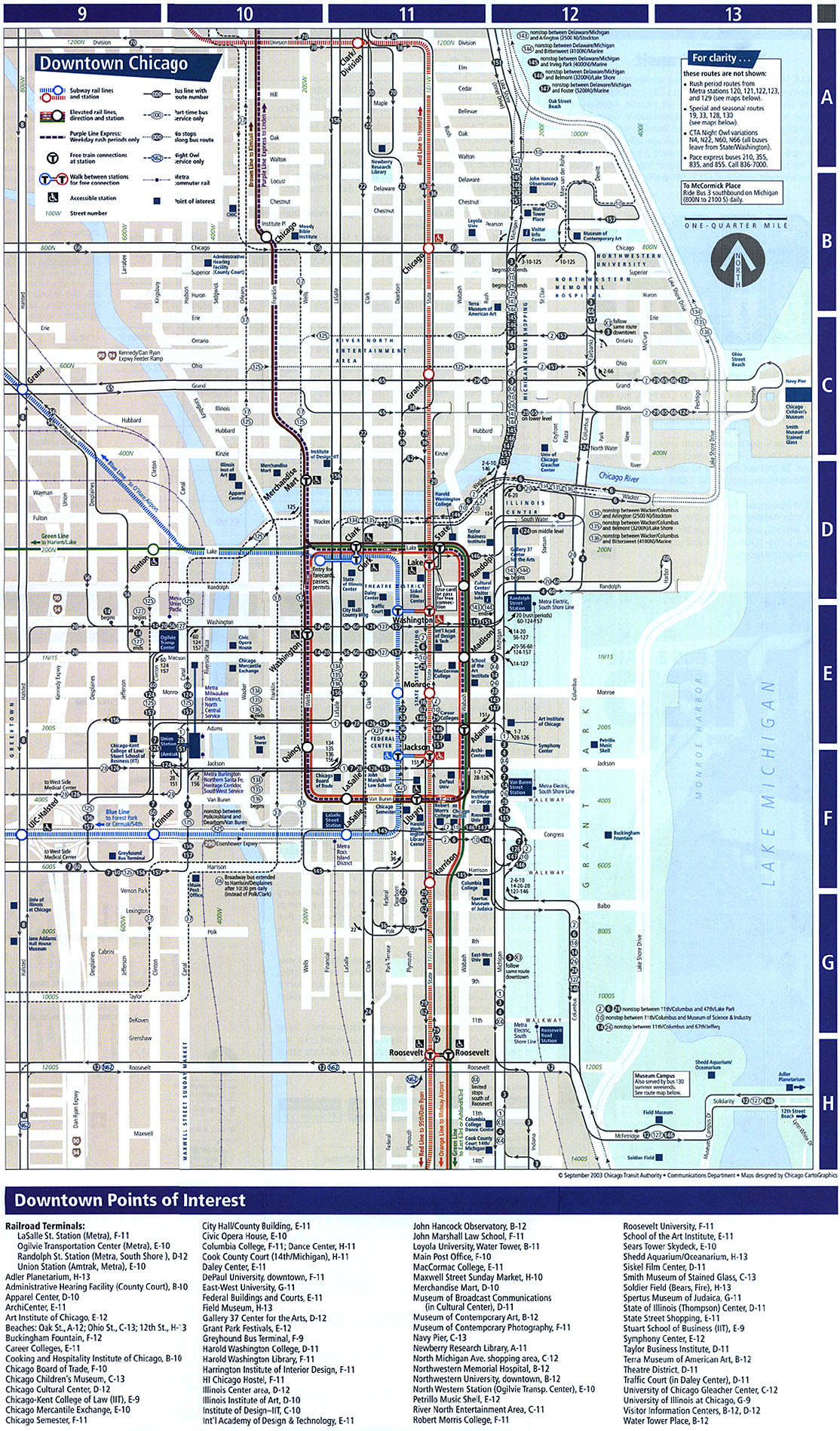
The better answer is that maps have several purposes and their makers often have different goals in mind. You can look at different maps of the same terrain made for different purposes and have it seem like you are looking at three different places. For example, look at these three maps of Downtown Chicago. They essentially depict the same territory, but were made in different times for different purposes (namely, land use, transport and recording a historical event).

Now, when you think about it, a map of the Chicago Fire of 1871 or the CTA map of the Loop is of use to some people, but not to others. What good would a historical map be to a modern apartment hunter? What good would a transit map be to someone entering the city by car? Not much is right. So, I take issue with the notion that using online map services for purposes of practical navigation is a bad thing or something that should be left to paper maps. These services have their place and they are very popular.

Second, I was interested in the way that Dame Spence decided to frame the issue. She framed it, without doing so expressly, in the classic dichotomy of "space versus place" and also from the standpoint of how and what the map depicts and how that relates to the landscape, the built environment and its history.

Space versus place is one of those arguments that academics (mainly geographers, but recently others have gotten in on the action) love to have with each other. Basically, the stripped down version is that a place is a space imbued with some kind of meaning. Here again, this is right from the Department of Tenuous Definitions, but it will have to do. Spence was saying that with satnav and online mapping, places were becoming spaces (in a manner of speaking).

I was also interested in her mention of the lack of historical and archaeological detail on the maps. This concern comes straight out of the maps produced by the Ordinance Survey (OS). Since the 1790's, the OS has been charged with the detailed mapping of the whole of the British Isles and large parts of their (now) former empire. OS maps, starting from their first large body of work mapping Ireland between 1828 and 1836, have a lot of fascinating aspects that tell us as much about the mapmakers as the territories being described.

The original OS maps of the 19th century bespeak of a country concerned with preserving its past but also looking enthusiastically toward its future. Sites of ancient ruins, cathedrals, stone circles and other such historical bric-a-brac were shown along side harbor improvements, the deep cuts for the canals and railways and other such modern bric-a-brac. These maps were bought not only by history buffs, but by land speculators, railroad developers, canal and turnpike companies and towns interested in development and the emerging discipline of modern town planning. They were truly showing the Britain of the 19th century as a place, imbued with meaning and indicative of its times.

These maps saw different users over the years, especially by hikers, bikers and other outdoorsy types. In these users, one can see a desire to maintain the landscape and monuments as a fragment of a deathless Britain even as Britain's imperial century drew to a close. This is along side the fact that, until recently, the best maps of the British Isles were produced by the Ordinance Survey, an executive agency of the British Government.

Thirdly, and this relates to the point above, it was interesting that Spence used the phrase "corporate cartographers" to describe Google and their kind. In defending the traditional (if you can call it that) mapping of Britain by the OS, she seems to be saying that the undying landscape and place of Britain was being hacked to bits or flat-out ignored by these corporate stooges, interested in getting people between locations, history and sense of place be damned.

Here is where I must part ways with Spence a little. Granted, the OS maps of Britain are great and you would have to go a long way to do a better job mapping the whole of a country. I own several OS maps and they are rich in detail and information about the topography and physical character of an area. They are also simply a joy to look at, following the contours in the map and in your mind.

That being said, I also agree that the OS maps have their function, but so does Google and other electronic, satellite maps. If I need quick directions, especially to an unfamiliar place, they are easy and readily available. This does not replace paper maps, which are often needed for greater detail or as a check against mistakes (which do happen with electronic mapping services).

Electronic resources, maps included, have the added advantage of being able to be updated in real-time, allowing travellers and local residents alike to respond to adverse weather conditions, roadwork, disruptions in rail or air transport and other highly variable conditions.

To the larger question of electronic resources "killing" off the extrordinary history of British places, I think that Spence's trepidation is a bit misplaced. Why? The reasons I gave above for different maps for different uses and situations. Quick directions are useful in some situations, but not in others. What use would they be if your intent was to wander around looking for something interesting? Not much, in fact, that activity might be best with no map at all.

So, I think that paper maps are in no danger of extinction because of the vital part they and their details play in how we conceptualize and represent places. They have been part of our symbolic language for centuries and they serve a great purpose. We think cartographically (to some extent) and these cartographic iterations help us to do that in different but not mutually exclusive ways. Google and good, old paper maps are both welcome.

To put it all another way, there is more than one way to answer Burt Bacharach when he asks "Do You Know the Way to San Jose?"

Burt Bacharach and cartography...what a way to end the week.

And Now, The News In Brief

I had some short things to say about recent news items that might be more important than people and their waning map reading skills. Seeing as I am a bit of a cartophile (my Master's thesis was based largely on critical reading of maps), I didn't think it was not important at all.

So, here are some news items and my (hopefully) short takes on them.
  • Now that we are between the conventions (Obama Media Love-In over, Mc Cain Scowl Fest to come), I think it is time to remind everyone of something before we all get carried away. Politics has, and has always had, elements of the theatrical at its very core. Statecraft is really stagecraft in large part. From displays at the courts of medieval and early modern Europe, to the grand architecture of government buildings throughout the ages to grand speeches and proclamations, the political leader is at once actor and policy maker. Ideally, the conventions should have not told you anything that you didn't already know. It is really all an act, put on to put powerful images in your brain and associate them with a particular person. It is branding at its best. I have always said that advertising is the great American art form, and no-where is this clearer than during an American political party convention.
  • A while back, Greg asked if I thought that Europe was ready for a leader of color. My answer was no, and that the US was more ready on that score. We discussed the matter (over Blatz, naturally) and came to the conclusion that it would so gall the Europeans to admit that we elected a black leader before they did. That means, in a certain sense, we are more progressive than them. Can you imagine the French, Dutch, Germans or any of them admitting that through clenched, non-floridated teeth? Well, this article in The Guardian may be proof of just that. Give it a read and tell us what you think.
  • While all of this convention mishegoss was going on, the world rolled on. Or to be more specific, Russian tanks rolled on into Georgia. There was an excellent piece in the Financial Times that I think gives a good read of the situation. I particularly agree with the point that Russia's claims of victimhood after the collapse of the USSR are rubbish. I also agree with the notion that when empire is lost, shame and disgrace are common feelings. Think of the British after, say, the Suez Crisis in 1956. Russia is losing friends and is blaming everyone but themselves. Keep an eye on this situation, folks. It could continue to get interesting.

Wednesday, August 20, 2008

Mental Health Time? Urban Isolation? Not Bullshit.

You know, it's funny. You can go your entire adult life confident of your beliefs and events can still over take you and cause a fundamental reappraisal of things that you have believed for years.

As you might have guessed, the beliefs that I am addressing are the relative bullshit nature of two concepts, those being "mental health time" and "urban isolation." We will discuss them in turn.

Mental health time, as I understood it, was time taken away from one's primary activities to gain some sort of mental perspective. I knew that it was related to stress and how people deal with it (see these guys for more info on that score).

Now, being the (usually) driven and ambitious person that I have always been, I thought that mental health time was a lame cop-out, an excuse given by the weak-minded for their failures to cope with the whirling shit-storm that is modern life. These people should quit whingeing and get back to work.

Well, um, this turns out to be not so true (for me, at least). A lot of things in my life were coming to a head at once (professional, financial, emotional) and I thought that I could soldier on and shrug it off easily (like I usually have before).

Not so fast, Will. Something was different this time. That something was urban isolation.

The term urban isolation describes a phenomenon that has been a part of the human experience since at least the time of the Industrial Revolution. People move to cities, away from their friends and relations and although they live in the midst of a teeming multitude, they still feel isolated and alone.

The usual perscription for dealing with urban isolation is to form a network of friends and meaningful associations to get you through the tough times and remind you that you are not alone. I usually have this, but because of the vagaries of academic and personal life, it was not as prevalent is it has been in the past.

I thought that urban isolation was bullshit because, well, I like being alone. I like spending time by myself reading, thinking or whatever (if I was a smart-ass, I would say here that spending time with myself is the best way to be assured of intelligent company). Anyone who claims to be isolated while surrounded by people is, well, either delusional or not trying hard enough.

Again, these assumptions on my part turned out to be rather wide of the mark.

So, in other words, I guess that need for mental health time + urban isolation = mental ground zero for me.

Worry not, dear readers. I am fine now. I retreated to my family and friends to, well, get some mental health time and remind myself that I am not as isolated as I might think. It did wonders for my mental state and I am back and ready to go again. We, as ever, have much to discuss.

Thanks for your continued support. Goodness knows I need it.

Friday, July 25, 2008

I'd Like A Quick Word...

Nothing huge today. Just some short thoughts on various goings-on and about things I have been mulling over as of late.

Oh, if you'll notice, I (slightly) changed the layout here, adding a blogroll and some links. Take a look there. You might find something of interest (or even your own site). If you read this space, and want me to link to you, just let me know.

Now, the scattershot musings:

  • This is one of the best written and funniest pieces on Barack Obama's image and media coverage that I have read recently.
  • I sincerely hope that this bill dies in the House or is killed by a veto. I promised no diatribe on this subject, but I will point out that if you eliminate or limit speculators, you give more control of energy prices to powers like OPEC. With a government-backed cartel like OPEC, prices only go up (among other really bad consequences).
  • Why does our society have such strange views on friendship? In the hierarchy of interpersonal relationships, why can't friendships be as deep/meaningful as marriages seem to be? I get the feeling (being familiar with the scholarship) that this was not always the case.
  • I have recently gotten back in touch with the work of Carl Sagan. I read The Dragons of Eden when I was in high school, but not much more. I saw Cosmos for the first time and was utterly enthralled. If there is a person who can explain scientific principles with more passion or simplicity, I don't know them. Click here for the introduction to Cosmos. Click here for him reading from his book Pale Blue Dot. You'll be hooked.

That's about all for now. Have a good weekend and remember, in the words of Carl Sagan that "we are all made of star stuff."

Friday, July 18, 2008

Sailing The Seas Of Smiles

First off, Dad, I answered your comment to the post below. I hope I didn't sound like a dumbass. I know I did.

Secondly, after the rather weighty posts of late, I figured I'd clue you good people into something really funny.

If you have not done so, you need to go right now and watch the hilarious Internet series Yacht Rock.

Click here for the homepage of YR. Click here for the dramatic final episode, which involves Jimmy Buffett's diabolical plot to kidnap Kenny Loggins and how Michael McDonald and James Ingraham save the day. "Ya Mo Be There?" You bet.

Basically, it is a series that explains the origins (?) of some of the smoothest music ever written. Main characters include Kenny Loggins, Michael McDonald, Walter Becker and Donald Fagen (Steely Dan) and more.

You will witness the birth of yacht rock (click here for a definition), the battle between Loggins/McDonald and Hall and Oates for yacht rock supremacy, the notion of yacht rap, Jetrho Tull (not yacht rock) and his magic fairy flute, the violent confrontation between The Eagles and Steely Dan and Kenny Loggins being lured to the dark side with promises of movie theme stardom (really, if you think about it, Loggins wrote just about every movie theme song from 1981 to about 1990).

You will also hear the sounds of smoothness and get carried away on the tide of warm, sunny musical perfection. For a good yacht rock playlist, click here.

So, dear readers, set sail for smooth music and I'll see you at the marina.

Have your doubts? That's what a fool believes.

Tuesday, July 15, 2008

Why Do People Vote (Or Not)? Part 2: Short Answer Portion

Well, it seems by the lack of comments and visits (thanks, stalking tools) that the idea of rational/irrational voters and the desire to vote was not as interesting to all of you as it is to me.

In that cause, I will make my statements short and provide you with links if you want to do some digging yourself.

Your Vote Does Not Matter: Strike One For Voting
It is a simple exercise in mathematics, which was done here by the very entertaining economist Steve Landsburg. He concludes, after comparing the odds in the lottery to those of your vote deciding the election, that (to give one example) you would have a better chance of winning the Powerball jackpot 7,400 times in a row than casting the deciding vote in the state of New York.

Pretty dismal, no?

So, if people are voting because they think their individual vote will decide the election, they either don't understand probability or choose to ignore it. So why do they go on?

Rational Ignorance: Strike Two For Voting
O.K., so you understand that your vote might not decide the election and, because of secret ballots, you wouldn't know that it was your vote anyway.

Are there any other reasons that arise from the long odds that should keep you away from the polls?

Yes, and that is where rational ingnorance comes into play. Read here for a more complete definition, but basically it boils down to the idea that because your odds are so long and becoming informed about the candidates and issues is costly in terms of time, effort and money, it is not worth it for you to be informed or care at all.

What personal benefit do you get from voting for one candidate over another? It is plain to see that one of the benefits is not the great chance that your vote will be decisive. There is a benefit that I can see one gaining by voting, but I think we'll close on that point.

Strike Three For Voting: Idiots In Large Groups
So, you understand that it is the best choice for you to remain ingorant on the issues, candidates and spend the time you would have invested in the election in doing something else...or do you?

Will, you ask, what if everyone thought like you and didn't vote? Wouldn't democracy collapse? No, because of the simple reason that most people don't think like me and still vote in the millions.

This raises the issues of group decision making and public choice theory. A detailed discussion of these ideas may be beyond the scope of this post, but a few remarks are in order. According to theories like Kenneth Arrow's "impossibility theorem," it is impossible in any system short of dictatorship to translate the choices of individuals into group preferences that meet even basic criteria for fairness. This, as mentioned above, relates to the larger field of public choice theory, wherein scholars have debated how this translation of personal choices into group decisions is to be structured to best reflect an overall preference. Most have said, however, that this is somewhere between difficult and virtually impossible.

Irrational Voters: Why Democracy Often Fails?
Allright, so, maybe, just maybe, people aren't voting for rational reasons. They are not seeking to maximize their payoffs and minimize their costs at all times and there are other reasons for voting. This has to be it, right?

Well, maybe. The work of Bryan Caplan, mainly in his new book, argues that rational ignorance does not give the whole picture. He asserts that voters are irrational rather than ignorant. He does this on the notion that while mistaken notions about some things in life (health, for example) are high cost, mistaken notions about economic and political issues are rather small in comparison. If I underestimate the high cost of juggling chainsaws, I will end up dead. If I understimate the cost of, say, immigration reform, what happens to me? Caplan argues (and fairly convincingly) that the same thing would probably happen if I knew nothing or if I understood the whole issue.

Which brings me to my final point...

Voting's Last Stand?
I had to think of something to say in favor of voting, if for no other reason than it seems that people are not going to stop doing it anytime soon.

This is an idea that has occured to me in the past, and it seems I'm not alone. Hey, if a really smart guy like Steve Levitt and I came up with similar ideas, well, perhaps I am not as big a moron as I sometimes claim.

The reason that I (and more eloquently Levitt) think people vote relates to seeking a benefit, but not the sort as described above. People vote simply so that others in their neighborhoods can see them voting and be seen themselves. It seems to be an issue of one's social image locally and a low-cost way to show one's dedication to the system that is supported by the act of voting. People, in other words, vote not approve or disapprove of a candidate or issue - they do it to seek approval for their behavior from their peers.

Now, I realize that there are critiques of voting from other standpoints, critiques that I think are quite interesting. Many of them come down to the point that voting is an act of acquiescence to a system that is in profound need of change. By not voting, one expresses their displeasure with the system and their desire to change it. This, for me, does not alter the fact that voting is a way of showing your personal preferences. It simply argues that your preference is for a different system alltogether.

In closing, I realize that there are a lot of open issues above, and a discussion of them could go in many different directions. I love talking about this stuff (as has become painfully obvious in this "short" post. Just let me know and we'll walk that rhetorical road together.

If not, well, I guess you have made your preferences clear to me on ONE score...

Tuesday, July 08, 2008

Why Do People Vote (Or Not)? Part 1: Definitions

It came up in the comments and discussion on my last post (and I indeed mentioned it) and I thought that a discussion of this topic would be fruitful for all.

(I realize that I didn't address the topic of Europe's readiness for a more ethnically diverse leadership. If you want me to do this, I will. I will say, though, that European societies have generally had limited success when it comes to integrating minority populations into their political systems.)

The topic that I want to address is expressed in the title to this post. It is a question that needs to be asked as we approach an election, already billed by some in the mainstream media as the most important in America's recent history.

What factors influence people's decisions in the voting booth? What do people figure they gain (or lose) by voting (or not)? Do people always vote for their sincere preference? If not, why not? Is voting rational? If not, why do people persist in doing it? If voting isn't rational and people shouldn't do it, is democracy just a cruel deception? Does voting represent a tacit assent of this fundamentally flawed system? If so, what should replace it?

It is to these questions that I will turn in a post (hopefully later this week).

First, though, perhaps some definitions and explanations are in order for those of you who are educated, but not familiar with the intricacies of voting theory, electoral systems and how voter behavior is studied.

Our Electoral System

In the United States, we use what is known as a simple plurality voting system. It is often also referred to as "first-past-the-post" (FPTP). What this means is that in any given race, the voter is allowed to pick only one candidate for each contested position no matter how many candidates are running. Having done this, the votes are counted and the candidate with the most (the plurality) wins. As we all know, the U.S. presidential election is done in a two-stage system whereby the voters are actually voting for delegates who will vote for the candidates in the electoral college. The efficacy and fairness of this system is a discussion for another time.

This will have a bearing on the further discussion of how people make choices when voting and also the choice of whether to bother showing up on election day. It also (via an idea known as Duverger's Law) suggests why we (and most other countries that use FPTP) end up with a political landscape dominated by two major parties to the exclusion of others.

What do I think of this system? Let's just say that I think it has its advantages, but the disadvantages may outweigh them in the long run.

Rational Voter: Useful Concept or Oxymoron?

In having the discussion that we will have about how people form their voting preferences, we need to be clear about how we define "rational." How I will use it (and, in many ways, criticize it) is not perhaps the way you understand it.

In this case, rational is taken to mean the condition where a person always seeks to maximize benefits and minimize costs. Rationality means that, in any given situation, a person will understand the options before them, understand the payoffs and costs related to these options and, having this information, will always make the decision that leave them with the best possible outcome.

This picture of a person as a self-interested, informed, strategic actor emerges from a branch of thought in the social sciences known as rational choice theory. Now, whether people are actually like this even some of the time will be part of our later discussion. I suspect, however, that there is some considerable truth to be gained from the idea of the rational voter, but ultimately it falls short of explaining the whole of voter behavior.

Why Should You Care?

I think the answer to this should be perfectly clear. I, for one, cannot help but constantly wonder why I do the things that I do and why others do the same (or not). Voting is one of these things. We are brought up from a very young age to believe that voting is our civic duty and that we must do it to have one's opinion on public affairs be meaningful. This relates to another term used by social scientists, political socialization.

I cannot help but wonder: why is this so? Is it because democracy needs the participation of the citizens? If not, why do it at all if your one vote is very unlikely to make a difference in an election? Is voting itself merely giving assent to a system that needs this sort of validation to continue? Do we really, despite our different choices of candidates, by voting merely give credence to a political system that is not what it seems (democratic)?

These are critical questions at any time, but they come to the fore during an election season where the supposedly rational voter is being barraged with images and propaganda designed to influence the decision-making process. My goal is to try and wade through some of this and get to the heart of the issue of why people vote and why does it matter.

Stay tuned; more to come on this later in the week.